


County climate action plan looks at building a lower carbon future
Administrator | Feb 14, 2026 | Comments 1
By Sharon Harrison
“What we are seeing now is a global threat; the global timeline for temperature increase has changed,” expressed Angus Ross, Climate Action Plan Working Group chair.
“Back when the Paris Agreement was signed in 2015, they were talking about limiting the increase in climate to 1.5 degrees Celsius. We have already hit that, and we will plausibly see a two-degree Celsius rise over pre-industrial levels within the next 10 to 15 years, and that has enormous impacts.”
The very real threat of escalating greenhouse gas (GHG) emissions in Prince Edward County, and indeed the world, and what that might mean going forward locally, was highlighted in a presentation by members of the Climate Action Plan Working Group at Thursday’s committee of the whole meeting.
Two years in the making, the Climate Action Plan final report, presented by working group members, chair Angus Ross and vice-chair Don Wilford, provides an analysis of community-wide GHG emissions in the County, and the options for building a lower carbon future.
The presentation and the report, extensive and informative in their design, and in-depth in its strategy, outlines evidence-based insights to inform climate mitigation and adaptation action. It is intended to support municipal decision-making and advance practical, achievable steps toward emissions reduction, resilience and long-term community well-being.
The report addresses local impacts and insurance impacts, specifically GHG emissions, realistic targets and essential actions. Ross also mentioned the things that council can control or influence, offering up six practical suggested next steps.
“Climate scientists have told us, do not go beyond 1.5 degrees Centigrade, so we are there,” added Wilford. “We can say with some confidence, we are going to hit two within 15 years at least, so we can’t predict the impacts.”
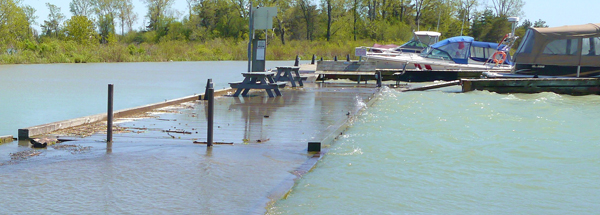
The boat launch and docks at Wellington harbour closed and under water as water levels continued to rise inn 2019. Sharon Harrison file photo
Wilford provided several examples of what those impacts may look like, such as longer droughts (notable was the extreme drought in summer 2025), vector-borne diseases (such as more tick-like diseases or even another pandemic), and extreme heat events (data suggests about a third of County residents have air-conditioning).

Beating the heat with a visit to the beach
“Imagine extreme heat with people disbursed across the County suffering from heat effects, and maybe no water. And so, what will the public health impact for the County be? What will you do?” said Wilford.

Storm rolling in at Pt. Petre. – Tina Thomas file photo
Other examples include extreme precipitation events (whether rain, snow or ice), more powerful storms, shoreline erosion, and more frequent freeze-thaw cycles and resultant infrastructure damage, as well as insurance concerns (unavailable or prohibitively expensive).
“What we are seeing now are huge changes by the insurers,” expressed Ross, who has around 60 years experience in the insurance industry. “They used to price your property insurance across the board, now they are mapping peril by peril: flood, hail, wildfire, overlaying the maps, and an additional charge goes on with each.”
He said most of the losses by the insurance industry for many decades used to be related to fire, but that has changed to water damage.
“If insurance is available as an option in high-risk flood plain areas, you could probably be looking at $10,000 to $15,000 as an annual additional premium.”
Ontario had about 36 per cent of Canada’s catastrophic events between 1983 and 2024, and 24 per cent of the insured losses, the report notes.
GHG emissions
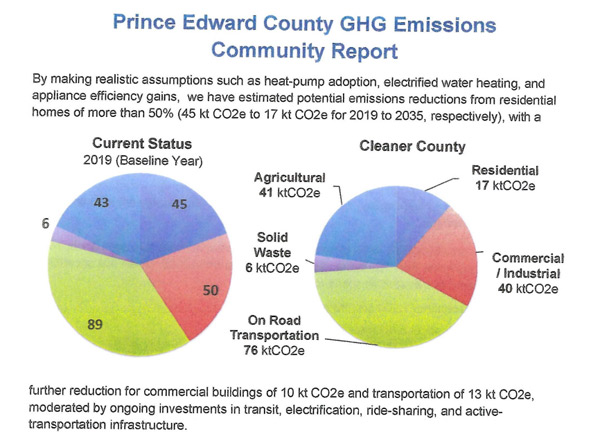
When talking about the number of kilotonnes (kt) of carbon dioxide equivalent (CO2e) GHG’s produced in the local community, on-road transportation ranks the highest contributor at 89 kt, with commercial/industrial at 50 kt, and residential at 45 kt –residential and commercial combined equate to approximately the same figure as transportation.
Agriculture came in at 43 kt, and solid waste at just six kt.

It was noted that community GHGs do not include the municipality’s GHGs (relatively small at seven kt), or Heidelberg Materials (at 575 kt).
“So, the big ones are buildings, transportation and agriculture,” said Wilford. “You know immediately looking at this, if we have population growth in the County, it’s going to increase GHG emissions via buildings and transportation.”
“And it’s also obvious that, if new development was green, and did not emit GHGs, then that would be the good thing to do, because the easiest emissions to reduce are the ones that you don’t produce in the first place.”
For buildings, it was highlighted how there is a high reliance on fossil fuels for heating and hot water use, how older buildings have limited insulation, and how new developments have not moved to electrification, geo-thermal or heat pumps.
“Proposed new developments and population growth make overall GHG emissions reduction unlikely without major change in building direction.”
Wilford said their analysis reveals a massive dependence on fossil fuels for heating with 76 per cent of heating in the County for buildings using fossil fuel. “We know that’s true for our vehicles, for transportation, but it’s also true for our buildings.”
For transportation, it was noted that fuel sales volume data is not available and could not be used in the research, with no data provided for propane, heating oil, geo-thermal and heat pumps.
Observations included how EV charging stations are still in short supply, and how public transit is improving, but could be improved further.
Notably, it was indicated that tourist emissions have not been counted under community GHG emissions, yet they increase community numbers by more than 60 per cent.
The transportation is a large element of the GHGs emitted in the County and there are certainly ways in which we can reduce it, Ross said.
Speaking to the inability to get fuel sales data, Ross spoke to it in relation to the County’s visitors.
“We know that we get a million visitors a year coming in, we don’t know how much fuel they purchase, and fuel sales are a real indicator of GHGs that have been emitted in the County,” he said.
He noted how there are a very limited number of gas stations in the County, and if the municipality were to ask each of those stations to provide the annual volume of diesel and gasoline sold, that would really be an indicator of how much driving is being done, and what the GHGs are.
A cleaner County
In order to achieve a cleaner County when it comes to GHG emissions, we replace all our furnaces with heat pumps, retrofit 50 per cent of natural gas and propane, adopt high-efficiency appliances, and double EVs to 10 per cent nominally, explained Wilford.
“What that gives you is a 22 per cent reduction in GHG emissions,” he stated. “And what that’s telling you is, realistically a 10 per cent goal is all we can do.”
When it comes to transportation improvements, things like electrification, ride-sharing, active-transportation infrastructure were among the suggestions for reducing GHG emissions.
New development
The number of houses that may or may not be built in the County is an unknown, but the report looks at what happens if an additional 1,000 new homes are built, looking at three scenarios.
Using conventional building methods will increase GHG emission 3.7kt per 1,000 homes (using 12 gigawatt-hours (GWh) of electricity); an “improved build” scenario (midway between current and ‘Cleaner County’) adds 2.4 kt per 1,000 homes (requiring 15 GWh of electricity).
“If we built clean, that is every new house has a heat pump -they can still have a furnace which is back-up heat or geo-thermal- and we assume 50 per cent EVs, we are down to 0.4 kt of emissions per 1,000 homes, and we would need 21GWh of electricity),” Wilford explained.
Councillor John Hirsch spoke to how the numbers will now provide a baseline going forward.
“The importance of these numbers is that we now have a baseline of emission statistics, so that three, five, 10 years from now, we can re-measure and see where we are at,” said Hirsch. “Have we succeeded in reductions, so that reduction targets are important, but it’s how we get there and what the baseline is that is critically important.”
There is no question that climate change is happening, said Ross in his final remarks.
“It’s happening faster, and it’s happening worse than the world anticipated. You can’t argue whether it exists or not; it’s a reality, there are consequences, there are costs and they must be addressed now or multiplied in years to come.”
“One-point-five degrees Celsius is where we are at: we should really be worried about two degrees.”
The comprehensive 24-page Climate Action Plan Working Group final report, “Prince Edward County Greenhouse Gas Emissions Community Report”, can be found on the County’s website. Also available is the 17-slide Climate Action Plan Working Group presentation, along with the meeting recording.
Filed Under: Featured Articles
































Ironic. While Angus and Don were giving a great deputation to the Council on Thursday, about climate and a low carbon future, at the same time, preident Trump was announcing his plans to abolish all carbon emmission roll backs and promoted coad and carbon burning industries and vehicles.
How will my future $3,000 heat pump save the enviroment now?
How do you go up against the problem from the south.
Good work by your group Angus