


Waring’s Creek water quality study amid impending development
Administrator | Feb 16, 2026 | Comments 0
By Sharon Harrison
A recent water quality survey of the groundwater table of the Waring’s Creek aquifer, consisting of six properties along Sandy Hook Road in Picton, were sampled for key water quality parameters by representatives of the Waring’s Creek Improvement Association (WCIA).
What was found is the Waring’s Creek aquifer exceeds provincial and national levels of contaminants, with ground water exceeding guidelines for multiple contaminants.
The independent sampling, undertaken in December 2025, consisted of five wells and one upwelling area (artesian spring) located just to the west of Sandy Hook Road and downslope from the proposed and on-going developments being opposed by WCIA, namely the proposed (deferred) Loyalist Heights sub-division and the (conditionally approved) Cold Creek sub-division developments.

– WCIA image
“Sampling shows that the water table contains high sodium, chloride (road salt run-off), as well as nitrites and nitrates from agricultural activity upslope,” stated WCIA’s stream and landscape ecologist Les Stanfield, who conducted the samplings. “The numbers approach levels that are unsafe to drink. This could have implications for the entire watershed, including wells, agriculture and West Lake.”
He said the capacity for the aquifer to accept any more contaminants is very low.
“Salt levels may increase with the new proposed roads. However, nitrates and nitrites may decrease with reduction in agricultural use. On-going monitoring will be undertaken.”
It was also noted that water quality data has been available to the County from the Conservation Authority monitoring and should have been considered in their deliberations for the Cold Creek development, according to Stanfield.
He explained the major concern over development in the headwaters of Waring’s Creek is whether additional contaminants would jeopardize human or aquatic life.
“Despite the WCIA and expert citizens raising this concern multiple times, no water quality sampling has been made available to the public that would demonstrate that the aquifer (the ground water) is healthy enough to buffer new contaminants that would surely come from the new developments, so WCIA decided to undertake their own survey.”
Stanfield noted that all but one sample had chloride levels above the Canadian Council for Ministers of the Environment (CCME) safe levels for aquatic life. He explained this chloride target is set at 120 mg/l; the average chloride level was 247 mg/l, with two sites exceeding the provincial water quality objectives for drinking water of 250 mg/l.
The same was true for sodium levels, he notes: all the sites were above the recommended provincial medical alert levels of 20 mg/l, and one sample had levels above provincial drinking water aesthetic guideline of 200 mg/l, results he describes as “terrifying”.
“The headwaters of the Waring’s Creek aquifer are severely contaminated with salt which threatens the health of all animals that use it,” revealed Stanfield. “Nitrate levels are also elevated, with an average concentration of 3.04 mg/l (exceeding the CCME guidelines for aquatic life).”
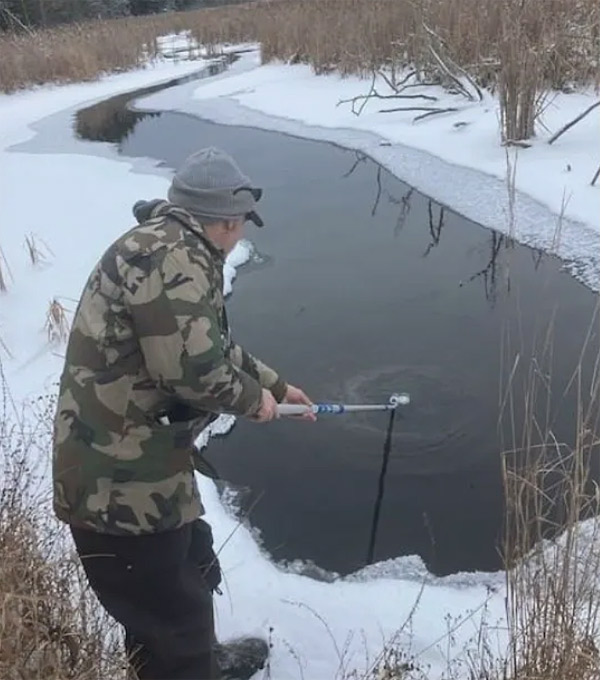
Sampling the artisian well – WCIA image
He notes how the artesian spring had the highest levels at 5.5 mg/l.
“At these levels aquatic life is in jeopardy; fish like brook trout are one of the most sensitive taxa to this contaminant. Even more worrisome is that both nitrates and salt are elevated,” he shared. “There is growing evidence that chlorides act to amplify impacts from nitrates and nitrites, so this double problem does not bode well for Waring’s Creek.”
Phosphorus was also elevated at two sites, he said, with levels in the artesian spring of 0.04 mg/l exceeding the provincial guideline of < 0.03 mg/l. “The exceedance of these levels in groundwater suggests that algal growth could become problematic in Waring’s Creek.”
There is some good news as bacterial counts were low, which suggests that there are no issues with local contamination from septic beds, he said, noting the problems stem from the upslope areas.
The Waring’s Creek headwaters are already above capacity to dilute contaminants.
“The headwaters show signs of severe overloading of the aquifer and the groundwater baseflow, and any more contaminants could be lethal,” he predicted.
“In comparison to the Ridge Road groundwater monitoring station operated by Quinte Conservation, the concentrations of chlorides and sodium are two to nine times higher at the Sandy Hook Road sites than this presumed reference site. Although even Ridge Road shows signs of increased salt contamination of the aquifer.”
He said there is also evidence supporting this conclusion from Quinte Conservation’s provincial water quality monitoring station at the bottom of the watershed that shows periodic pulses of contaminants above the provincial or federal guidelines – public data that the County and the developers should be aware of, he notes.
“The Provincial Planning Act prohibits development on lands that would cause aquifers that support cold water streams to exceed provincial or federal guidelines,” commented Stanfield. “If this information had been revealed at an earlier date, the guidelines would have prohibited decision makers from approving any additional development until the aquifer was remediated.”
“To my knowledge, the fact that water quality sampling of the aquifer has not been reported is highly unusual, as proponents are directed by policy to ensure the aquifer will not be impacted by their development. It is not sufficient to just say, we will have no impact, it must be demonstrated.”
This requires testing to ensure the aquifer is not already exceeding its capacity, he explained.
“These results are extremely worrisome for the future of Waring’s Creek and for the people and livestock whose drinking water is being affected,” he shared.
The survey results suggest that any new development should not occur until the aquifer is remediated, he said. “This will not be easy. And to accept that new development will not exacerbate the issue is folly.”
He also stated how salt and other contaminants are poorly managed in the County.
“We over-salt our roads and parking lots and store salt poorly. Nitrates and phosphorus are often over-deployed as fertilizers. It will take a concerted effort to reduce the use of these chemicals in this watershed (and beyond), and monitoring must be initiated. “
“We cannot put people’s health and our ecosystem in jeopardy, it is too important,” Stanfield concluded.
The full water quality study can be found on the Waring’s Creek Improvement Association’s website at Waring’s Creek Water Quality Study
Details of WCIA’s recent legal challenge against the County’s decision in approving the Cold Creek residential development application can be found here:
Waring’s Creek group disputes legality of Cold Creek approval
Filed Under: Local News