


Bloomfield Day celebrated the village’s past and present
Administrator | Oct 04, 2026 | Comments 0
By Sue Capon
Caroline Henry spotted her dad right away in one of many vintage photographs on display at the Bloomfield Library, on Saturday.
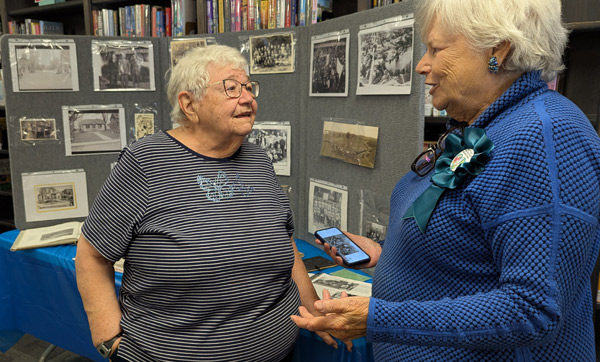
Caroline Henry speaks with Marilyn Toombs, a Friend of the Library member, about the photographs displayed.
The display was part of an afternoon hosted by the Friends of the Library, celebrating the anniversary of “Bloomfield Day” – Oct. 3, 1883 when the village was named.
More than two dozen attending the event browsed the photographs and books from the Fraleigh family and Phil Ainsworth collections, as well as the County of Prince Edward Archives.
Henry is the third generation to live in her house in Bloomfield.
“It was my grandparents house on dad’s side of the family. She remembers that back then, children played all over the area. “Whoever had the best supper, that’s where I invited myself,” she chuckled, adding that was the way the community took care of its children. “I always felt safe… and got home before dark. We were always home before dark because our parents had to go to bed early, most of them had to be at the canning factory.”
Henry noted they lived “behind what we call the block” referring to the Saylor Block on Main Street, the largest building in the village.
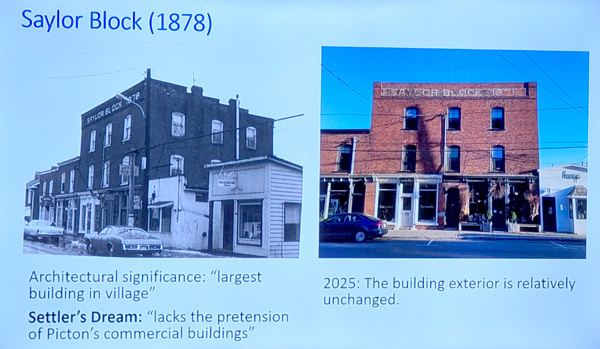
The Saylor Block was among many stops made during a slide show presentation by Liz Driver, president of the Prince Edward Heritage Conservancy. She used the Historical Architectural Survey of Prince Edward (HASPE) collection to speak to how Bloomfield has changed, and stayed the same, over the years.
The HASPE collection was created in 1981 by Tom Cruickshank, with Peter John Stokes, and documents about 4,300 historical buildings in the County. Their chosen best and brightest from the research then formed their well-known book The Settlers Dream (also with John de Visser).
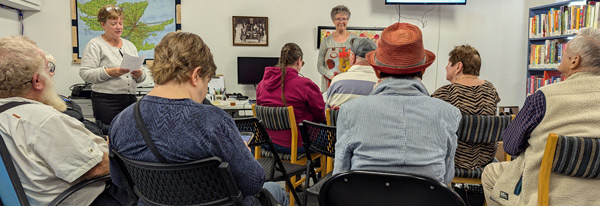
Denise Boos, Chair of the Bloomfield Friends of the Library, introduced Liz Driver
The HASPE documents of inventoried properties, Driver noted have become a touchstone for measuring change. The 116 three-ring binders of descriptions and photographs are slowly being digitalized to make them more accessible.
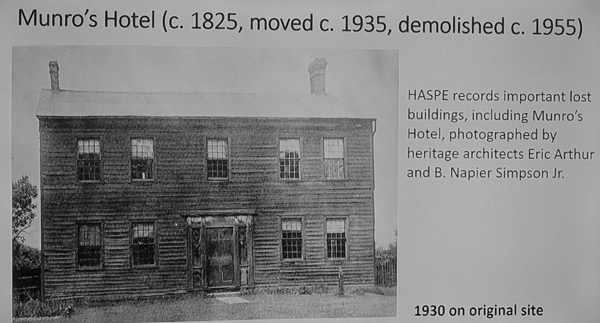
Munro’s Hotel, circa 1825, Driver noted, was the first photograph used to introduce The Settler’s Dream book. The building was since demolished.
Munro’s Hotel, Driver noted, has what is called 12 over 12 windows.
“What you have is 12 panes of glass on the top, and 12 panes of glass on the lower sash. And that’s because up until the 1840s, Britain had a monopoly on glass and the only way you could have glass here is you bought the teeny tiny panes sent on ships.”
During a meeting at George Munro’s Hotel, it was resolved by residents that the village should be called Bloomfield, after a Captain Bloomfield, owner of several ships. It was previously known as Bull’s Mills, after saw mill owner John Bull.
Bulls Mills was one of four, the others being Bowerman’s Mill, White’s Mill and Clark’s Mill.
The Beldon Atlas map of Bloomfield 1878, Driver noted, “showed a heavily forested village of farm lots, the basis of early prosperity”, concessions and larger homes at the west end.
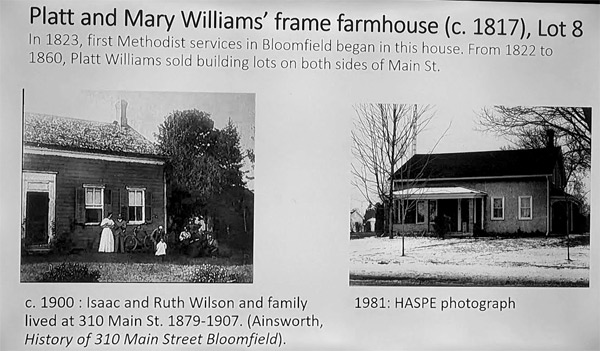
Among the significant homes is the Platt and Mary Williams farmhouse. Driver noted that in 1823, first Methodist services in Bloomfield began in the house as there was no church or meeting house then. Sharon Sibthorpe (and Derrick Prinzen) have made it their home for many years. Sibthorpe is also a Friends of the Library member and proudly notes theirs was the first home in Bloomfield. An early photograph of it was used in a game for visitors at the the day’s event to “guess the house.”
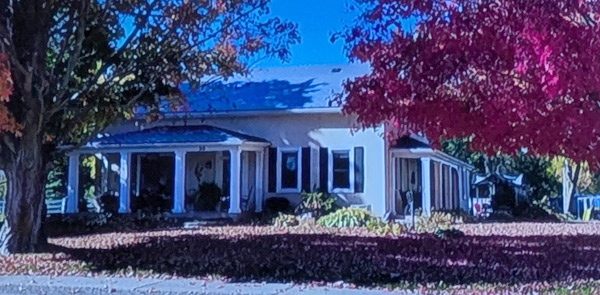
The Platt Williams (Prinzen) house now
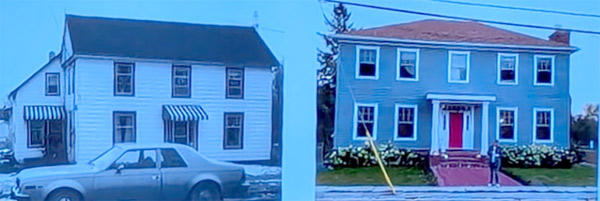 Across the street, what was known as the Lammes, then Fox house, was torn down and now is a large neo-Georgian home on the same lot.
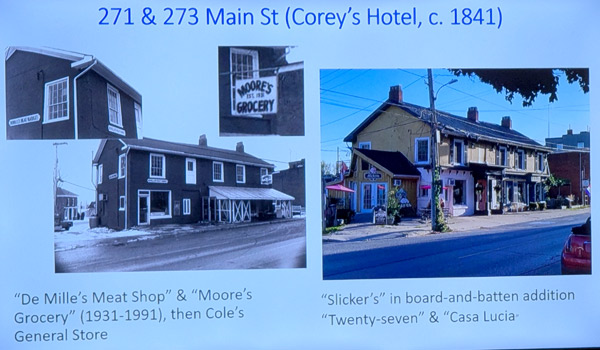
The block of stores including 271 and 273 Main form what is called a “street wall”, Driver pointed out. “It’s sort of characterized by large brick blocks and all the buildings are attached… and you can see how the ice cream store was added on later.”
Caroline was also pleased to see the old photograph of what is now known as Green Gables.
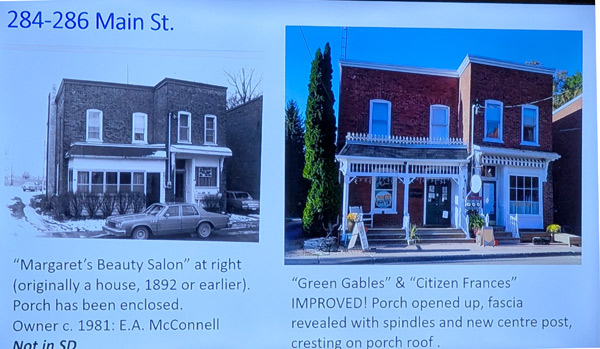
“That was Bob’s Barbershop. Bob’s wife was related to me. There’s a beautiful bannister in there that I used to slide down!”
Filed Under: Arts & Culture • Featured Articles