

Call to return Macdonald statue to Picton Main Street fails
Administrator | Apr 22, 2026 | Comments 0
By Sharon Harrison
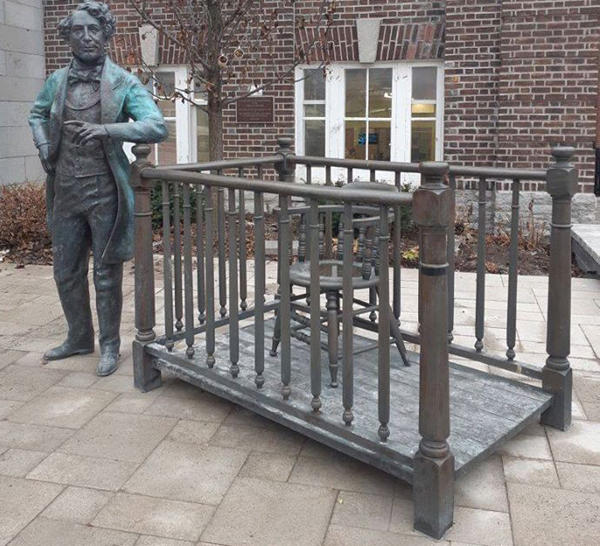
An emotional and sensitive topic for some, a divisive one too, Sir John A. Macdonald, and specifically the statue that once stood outside the Picton branch library on Main Street – before it was removed after much public upset and controversy – was back before County council Tuesday.
Mark Johnson, with Save Our History, asked council to consider having the ‘Holding Court’ statue reinstalled in the original spot outside the library, where he requested staff produce a report on costs, a consultation process and plaque wording.
Save Our History is a non-partisan, grassroots movement formed just over a year ago dedicated to preserving and celebrating Canadian heritage by protecting historical statues and school names.
“The request I am making is not in any way to diminish or decrease the tragedy of residential schools or Indigenous history, and how we in Canada need to improve the lives of Indigenous Canadians,” stated Johnson. “Instead, it is about the rightful place to honour Sir John A. Macdonald, and in particular, the statue here in Picton’s Main Street.”
He described the tearing down and removal of Macdonald statues across Ontario (and Canada) – nine in total between 2018 and 2021- as an “emotional reaction primarily in response… what the catalyst was, was the Kamloops residential school discovery, so that provoked a very strong response”.
“We believe that response and tearing down of the statues and removing them was too rash for reasoned conversation and debate, and ultimately it was very damaging to our sense of history and the conversations that actually should ensue as a result of learning more about our history.”
Speaking to why raise this topic again now after five years, Johnson suggested “some passions have cooled, and we do have a better and more nuanced understanding of Macdonald’s role in residential schools, and also there has been important conversations about Macdonald in the years since.”
“You mention that passion cools, I don’t think it does,” voiced councillor Sam Grosso, “Pain doesn’t cool, pain stays.”
It was revealed that Johnson had not engaged with the library board about his request, nor the artist, nor consulted with local Indigenous peoples, specifically the Mohawks of the Bay of Quinte, where Johnson said his presentation was just a preliminary discussion and request.
Extensive and prolonged discussion ensued around the horseshoe (in addition to an hour of closed session prior to the public part of the meeting) which involved some significant, intense and in-depth history lessons (and many quotations) contributed by councillor Bill Roberts in his attempt to educate on Canada’s first prime minister.
A motion brought forward by councillor Brad Nieman to direct staff to engage with the artist and stakeholders with the aim of exploring the feasibility of bringing the statue back to public viewing, failed in an 6-8 recorded vote. Voting in favour were councillors Janice Maynard, Roy Pennell, Bill Roberts, Phil St-Jean and David Harrison, along with Nieman.
Nieman reminded that council made a motion in 2021 to decide on how to proceed, stating that five years later, it is still “unfinished business we should be coming to a conclusion on, one way or another”.
Councillor Kate MacNaughton asked for the wording in Nieman’s motion to be reworked to indicate, “…with the aim of determining the future of the statue…”. “It doesn’t presume an outcome, it presumes a process, so the correct outcome can be agreed upon by our community,” she said. But it also failed in a 10-4 recorded vote.
“Where does this leave us?” asked councillor Phil St-Jean. “There is no resolution whatsoever at this point, so where do we go from here, because there are going to be statements and questions from the public, they deserve answers.”
Chief Administrative Officer Adam Goheen confirmed there is an outstanding council motion to direct staff to work with people in the agreement to return the sculpture.
Notably, council made its decision on the motions before comments from the audience were heard, a point which also garnered debate by several councillors.
A packed and vocal Shire Hall gallery heard 14 members of the public voice opinion, including from some business owners and local organizations, along with two authors, the majority of whom who indicated they were against the statue returning to Main Street.
Raw and emotional at times, comments ranged from angry to factual to thoughtful, and thought-provoking, as the vast array of opinions, statements and thoughts dove in the history, not only of Picton’s statue, but primarily of Macdonald’s history, especially as it relates to residential schools, and the discovery of the 215 unmarked graves in Kamloops in 2021.
Councillor Roy Pennell said he supports maintaining and protecting history, saying it is important to know the good with the bad.
“We can’t brush under the carpet history; our kids need to know what our history is truly about,” expressed Pennell. “By hiding something is nothing to help out history. We have obligations which has to be sorted out. This is a starting point for discussion.”
Roberts attempted, at length, to balance the conversation, not only acknowledging Macdonald’s failures, but also highlighting his achievements and good work.
“When erasure and boxing-up and cancelling becomes the safest form of expression in a society, we have yet another serious problem for liberal democracy,” expressed Roberts. “Ideally, public debate should push our way of thinking, push our boundaries a little bit, beyond immediate prejudices, beyond social media anger, to places we haven’t personally considered before, or been before, and if we don’t do that, we are never going to get to a real truth and reconciliation.“
Author and historian James Stewart has written a book about Canada’s prime ministers and is a fan of statues where he said they are an invitation to talk about history. He said he thinks there has been a lot of misunderstanding about Sir John A. Macdonald, where he acknowledged that he has a special place in the County, in Kingston and across the country.
“When we put statues away, I think we are closing off our history, and when we have statues out in the open, we are inviting our young people and the public to have a conversation about the history of Canada,” expressed Stewart. “When we put it away, that seems to be the easiest way out rather than embracing the challenges of a country that has a complex history, but a rich history.”
“When statues were taken down, it was done through a period of unrest, it was done under a period of rushes to judgement that were not well-informed by history, and it was more reactionary rather than thoughtful,” he added.
Objecting to the reinstallation of the statue in any prominent outdoor location, and especially so in front of the library, Christine Renaud said it is worth remembering that regardless of what so-called ‘good’ Sir John A. Macdonald may have done, he is responsible for “abhorrent acts of racism that reverberate through the lives of Indigenous peoples to this day”.
“Not having a statue on the Main Street doesn’t erase history, it’s ridiculous,” expressed Renaud, “it simply puts Macdonald’s story where it should be. Not revered in public space, but presented in history books, classrooms and museums as might be done by the Holding Court sculpture, if need be that it has to be somewhere, into the Path Forward exhibit now in our Macaulay Museum.”
“I don’t think you can excuse what has happened to Indigenous peoples, the things that were done, the legacy… no one is saying erase history, the debate here is, should that statue be on Main Street? No, its harmful, its divisive, and it will only cause more conflict, and it doesn’t, more importantly, give the opportunity to do robust education that is required.“
Roberts reminded that Macdonald died in 1891, and residential schools became mandatory in 1920. He also said if there was no Sir John A. Macdonald, there’s no Canada.
“Without the determination, I believe Canada would not have come into existence some 160 years ago,” said Roberts. “Our first prime minister was actually directly and deliberately responsible for saving Indigenous lives, and future Indigenous nations, or at least trying his best with the limited resources they had.”
“We don’t necessarily always have to celebrate our history, but we should remember it and do our best to understand our history as our collective understanding of that history evolves.”
“I am beyond enraged that we have to keep excusing this, and want so desperately to have this statue in public view,“ added Renaud. “This is about not harming people, period.”
The presentation and the meeting recording can be found on the agenda for the April 21 council meeting on the County’s website.
Click here for an extensive selection of background Sir John A stories
Filed Under: Featured Articles • Local News