


Cyclists don’t feel safe on County roads: Legge
Administrator | Feb 28, 2026 | Comments 6
By Sharon Harrison
For the optimists out there, cycling season is just around the corner, even if the snow-covered County landscape indicates otherwise as winter appears reluctant to release its icy grip. But it’s coming, hopefully.
Cyclist and cycling advocate Rob Legge, representing CYCLE PEC, a community-based group promoting cycling in Prince Edward County, spoke to the traffic advisory committee this week. His deputation addressed advocating for safe cycling, where he also highlighted how County roads can be made safer for not just cyclists, but for all road users.
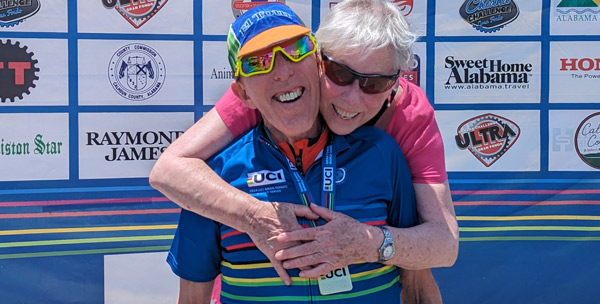
Rob Legge receives a hug from his wife, Kathy, after winning (for the fourth time) the Cheaha Challenge in Jacksonville, Alabama – a 130k qualifier for the worlds in Denmark.
Legge’s request was for practical, cost-effective steps to be taken to improve cycling safety in the County, not as a special interest request, but as a community safety infrastructure and economic development issue, he explained.
Speaking to the reality of safety for cyclists, he said current challenges include inconsistent paved shoulders, partial shoulder re-surfacing creating hazardous ridges, limited road markings, inconsistent signage, and reconstruction projects that don’t consistently incorporate cycling infrastructure.
CYCLE PEC’s list of recommendations, which he calls practical, achievable steps, include upholding the Cycling Master Plan, include paved shoulders in new construction, fully re-surface roads and shoulders (the entire width as partial resurfacing creates edge drop-offs), use clear road markings (edge lines and bike symbols), and commit to equal safety for cyclists.
Legge’s immediate ask calls for the installation of “share the road” signage, which he describes as a low-cost, highly visible and immediate option, and, along with road markings, is a relatively inexpensive safety measure solution.
“It enforces driver awareness and clarifies expectations, and supports enforcement by removing ambiguity about whether a cyclist belongs on the road.”
Committee agreed that Legge, who is very familiar with the most common bike routes in the County, will provide a list of the most appropriate locations to install “share the road” signage for the committee’s (and ultimately council’s) consideration.
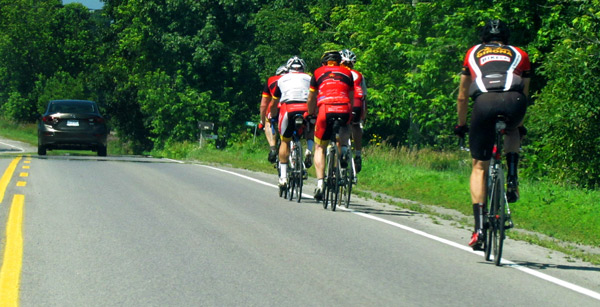
Legge has taken on the world’s best bicyclists in his age category (75-79) in international races. He trains on County roads and also races with other local cyclists annually to raise for the Princess Margaret Cancer Research Centre.
Also on the group’s wish list is including paved shoulders in new construction which benefits cyclists, farm equipment, emergency vehicles, motorists during breakdowns, snow storage flexibility and increases recovery space, he explained.
“A great example is Highway 62 which has paved shoulders that are really wide. When major projects occur, such as County Road 49, paved shoulders or cycling lanes must be included as a standard safety feature,” he noted.
“When only half a paved shoulder is surfaced, it creates a raised edge, loose aggregates, an unstable riding surface; for a cyclist, that ridge can mean a crash.”
When County Road 49 is re-built, if paved shoulders are not included, he said “we lose a once-in-a-generation opportunity to design safety for the next 30 to 40 years”.
Committee chair, Kelly McGillivray, noted the biggest concerns with roads is budget.
“We’ve got a lot of roads, and not a lot of people to pay for them,” expressed McGillivrary, with Legge adding that was why he was suggesting to start with signage.
She said while there are a lot of kilometres of roads, there are many small rural roads where it really isn’t dangerous to be biking.
“It’s those County roads and arterials that are the ones that are more dangerous. “Share the road” has really pointed to those arterial roads that do not have a paved shoulder that is adequate for cycling, and that’s where you have to say, there may be bikes on this road in the same lane, and that’s a different story.”
“I understand that council must consider cost, but the most effective time to add safety infrastructure is during planned construction,” said Legge. “Adding paved shoulders during a re-build is far less expensive than retrofitting later.”
Councillor Sam Grosso was in agreement with having shoulders on County Road 49.
“On 49, I love the idea of shoulders on there as its going to be re-built hopefully, so I love that idea, but we also do have 1,100 kilometres of roads, so it’s a really uphill battle,” said Grosso.
Legge added how it’s currently “impossible” to ride on County Road 49. “It’s really important as it’s a really great avenue to get into the County for cyclists, and for people that live around there, or who are walking on the roads.”
Legge said cyclists are legitimate road users under Ontario law, yet many County roads have cyclists feeling exposed and vulnerable. “My request is straightforward: let’s make cyclists feel as safe on County roads as drivers do,” he expressed.
He said this matters because Prince Edward County is a cycling destination, a tourism-driven economy, a rural road network with increasing traffic, and a community that values health and active living. Also noting how safer roads benefit everyone, not just cyclists, but drivers, pedestrians, residents, visitors and businesses.
There must also be a commitment to equal safety for cyclists, he said, explaining that drivers expect smooth pavement, clear lanes, predicable edges, and for cyclists to obey the traffic rules.
“Cyclists deserve the same standard of safety. Equal road access should mean equal consideration for safety,” he added. “In short, good road design is a public safety tool.”
From an economic development perspective, Legge touched on the cycling visitor experience and its economic impact for the County and its businesses.
“A tourist cyclist in Ontario typically contributes to about $100-$150 per day at minimum, and often $150- $250 per day when accommodations, meals and local businesses are included,” he shared. “At the same time, many residents cycle for fitness, transportation and recreation, but the number one reason people tell me they don’t cycle more in the County is, “I don’t feel safe”.”
Filed Under: Featured Articles • Local News































I’ve never used a blaring horn to let a row of cyclists know I wish to pass..always a light “toot-toot-toot” but still have gotten the finger and a dirty look. Riding in pairs should not be allowed as it narrows the passing lane and obviously holds back traffic..but it happens. It’s a two-way street in that some cyclists and drivers do need some courtesy correction. I’m wondering what the rule “of thumb” is when biking the narrow,crumbling roads of PEC.? Perhaps the leader of the group should ride in the rear to police the actions of the rest.
Sadly North America compared to many EU countries and Asian countries is not bicycle friendly. There are many pockets of bicycle friendly communities in North America. There aren’t any good reasons why the County cannot be a bicycle friendly area. Especially being a global destination for stays and visits. The value added as Bob states are there. It is just a matter of priorities.
I don’t feel safe driving in a car on my road. The posted speed limit is 60 km/h, there is no safe way to travel at that speed due to the pot holes. How about we make our roads passable for all, so I can get to work without incurring added costs having to fix my car. The bonus of this is that I can make some money to pay my TAXES, that apparently don’t go to fixing roads.
I live in town, on a side street, and I DON’T FEEL SAFE. Vehicle traffic, including commercial trucks will cause a fatality. It’s only a matter of when, not if. I made a presentation to the Traffic Advisory committee a few years ago, but nothing changed. We live in a reactive environment, where being preventative is too costly.
An important ignored point; Motorists are required by recent transport law to give 36 inches clearance to cyclists.
I rely on the free bike map of the County published by the the Bloomfield Bicycle Company. Choices of safe and unsafe roads and routes to places are readily made. I love their map, and it helps me feel safe cycling here.