


Disraeli housing to be ready this year; Niles project a few years away
Administrator | Mar 27, 2026 | Comments 0
By Sharon Harrison
An update from the Prince Edward County Affordable Housing Corporation (PECAHC) on the status of its long-stalled few projects was received by council this week.
The update was promised at the January council meeting (see that story below) to deliver some good news and councillor Phil St-Jean, chair of the corporation, accompanied by councillor Brad Nieman, vice-chair, delivered a long and detailed -presentation diving into PECAHC’s activities from inception seven years ago to now.
An overview of progress to date was provided on the two languishing main on-going proposed affordable housing projects: 230 Niles Street (former Duke Dome arena in Wellington), and 30 Disraeli St., Picton.
In short, the big news was the construction of the Disraeli Street project is to begin next month, with occupancy expected in the last quarter of this year.
It intends to provide eight rental housing units, of which three will be affordable, a small point omitted in the presentation and a detail which councillor Bill Roberts called out. The remaining five units are to be at market rate. Originally, the Disraeli project was a 12-unit, four-storey apartment building for the purpose of affordable housing to consist of six bachelor units (450 sq-ft each) and six one-bedroom units (600 sq-ft each), to be operated by the PECAHC.
“You’ve mentioned several times the eight units at Disraeli Street, they are not all affordable units….so, for the record, my understanding is, five of those are market value, and only three are affordable units, and that’s an important correction that wasn’t made in this presentation,” stated Roberts.
St-Jean responded by saying that affordable and attainable housing cannot be built without somebody subsidizing it.
“That is a fact of the industry, and when it comes to building these eight units, three of them affordable, the balance market; and those market ones are the ones that allow us to create those three units, which is 38 per cent… better than a lot of developers who barely give us five [per cent],” said St-Jean.
“In the envelope of managing public expectations, at the end of many years, three units… I think you know what I am getting at,” Roberts added.
St-Jean countered by saying that funding is needed to produce more affordable units. “The best we can do at this point is three affordables and five full market, that’s the economic reality we are in.”
The long-stalled Niles Street project on other hand has encountered numerous challenges in recent years, especially regarding environmental concerns, where it was noted that they were looking at site development at the end of 2027, with the RFP (request for proposal) process to begin in the second quarter of this year.
Councillor Chris Braney said County residents are getting impatient when it comes to affordable rental housing options.
“We’ve had the affordable housing corporation for seven years and we’ve put a lot of money at it municipally and we haven’t even produced a single unit,” said Braney. “My dilemma is the confidence… this is costing the municipality a lot of money, something needs to happen very soon because the mandate is, we need to create affordable housing for County residents first and foremost, that is paramount. As a councillor, I am losing confidence.”
More details on both the Niles Street and the Disraeli Street projects can be found below.
The presentation covered the corporation’s evolution and its mandate, and introduced its board of directors. It also addressed the funding applications applied for (denied and received), as well as explaining how the development process works, and outlining how building new residential units is hard to do, and targeting affordable rental housing even more so.
“Quite simply, we are here to share the accomplishments, the hard work, help everyone understand what has been going on specifically in our term (since Jan. 2022)… there is a fair bit of misunderstanding in the community about what PECAHC has been up to,” said St-Jean.
There has been a lot of work by a lot of people in our community, including that initial board that was appointed in 2019, he said. “We’ve been here three-and-a-half years and a lot of work has began, and there’s a lot more to do yet, but we are starting to feel that excitement that things are finally happening.”
Nieman explained the corporation’s mandate is to pursue affordable housing through owning and operating, or public-private partnership, also to seek and secure funding through funding programs sponsored by upper levels of government, or other available programs.
The process of funding for their proposed projects was explained by St-Jean, who said that over the years they have applied to many funding sources, only to meet a couple of successes and a lot of struggles.
The successes he called pre-developed through CMHC (Canadian Mortgage and Housing Corporation) he said, where he confirmed they received funding for some of the pre-development costs for the Niles Street project in the amount of $180,000, as well as $100,000 for Disraeli Street.
He stated there were many applications for programs over years and many denials.
“I know there is some misunderstanding about why the denials, but in most cases it simply was that our projects weren’t big enough to fit the very large programs that were trying to be developed, whether it was federal or provincial.”
“The one thing that people need to recognize is that over $4 billion that the federal government allocated to all municipalities, and created the application process, in reality it was targeted to large urban centres with very large projects,” said St-Jean. “Prince Edward County is not a large urban centre; nor did it have very large projects, so we struggled with meeting some of that criteria.“
As far as current funding options are concerned, he did say the much-touted Build Canada Homes (BCH) program is being investigated.
“Hopefully, we will be successful in receiving a positive for a change with BCH which will help us to fund the Disraeli Street project, and most likely the Niles Street project, but it’s a work in progress.”
He also added that CMHC has allowed some pre-approved lenders that allows the corporation to go the private market route, something St-Jean said was not permitted previously.
“Even though we receive denials, we continue to work diligently, we are not giving up, and we did not give up, and we have been flexible, trying to find every avenue to make affordable and attainable housing a reality here in the County.”
It was noted by St-Jean that there has been some commentary about a lot of municipal taxpayer money being spent, where he noted the total amount transferred from the municipality (taxpayers) to the housing corporation over the seven-year period is $770,000.
In both 2019 and 2020, $250,000 for each of those years was given to the housing corporation. In each of the 2021 and 2022, that sum reduced to $135,000 in each case. St-Jean noted that since then there has been no money, grants, direct funding or subsidies forwarded to PECAHC for its operations in the last four years, since 2022.
The presentation, and the meeting recording, can be found on the County’s website.
Councillor questions if County should be in the affordable housing business
Homelessness and housing hampered by government funding constraints
More details on the Niles Street project (Wellington), and the Disraeli Street project (Picton) below:
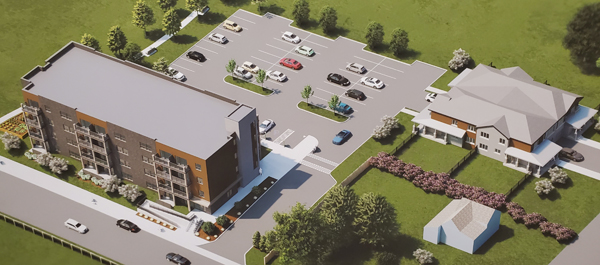
Niles Street project
The old Duke Dome at 230 Niles Street in Wellington, now an empty site awaiting construction to happen, was transferred from the municipality to the housing corporation in June 2020.
It was known at the time that some form of remediation would be necessary at the site noted St-Jean, as it was an old arena and much testing ensued. He said originally it was thought 160 tonnes of soil would need to be removed due to various contamination, which ended up at 230 metric tonnes, and which was replaced in order to have a clean surface.
Along with that came the multiple challenges to achieve that record of site condition, which included a process of taking soil and groundwater samples, in order to meet certain contaminant levels, a process St-Jean described as “very rigorous”.
Speaking to the potential collaboration with the Wellington Storehouse Foodbank, St-Jean confirmed that the foodbank had approached the corporation some time ago with an interest in building a new foodbank in Wellington.
“The board agreed we should enter into a conversation with them to see if we can make it work, and can we incorporate what is clearly a big need with our needs to provide, and is there a partnership we can work together and help each other.”
He said those conversations were started, with more conversations to have, but noted with the passing of the foodbank’s executive director recently, there are still some challenges for the foodbank, where he said it is in their hands at this point when they are ready.
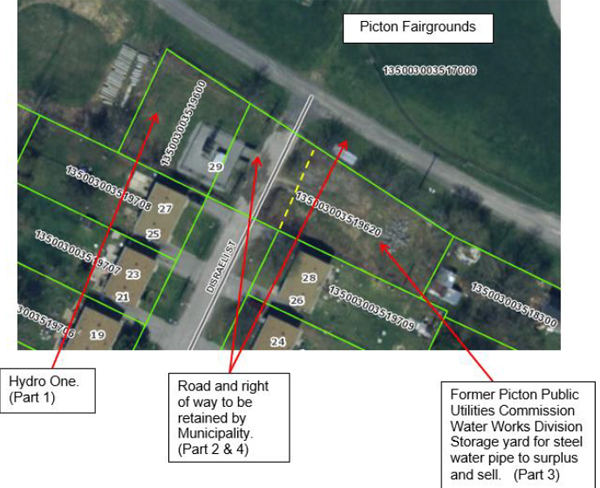 Disraeli Street, Picton
“This is one that we have been pushing as it seemed like a good win for us and one we could attain pretty easily,” said Nieman, noting the property was transferred to the housing corporation in 2021.
Members of the working group visited two Theberge work sites in Ottawa in January, one under construction and one a finished product, where Nieman noted how the units being constructed were in place in two days, noting the quick process. They were also able to visit the second site with a completed building and go inside one of the units which was being lived in.
“This construction addresses climate change, it uses green energy, heat pumps, solar panels, its very energy efficient,” confirmed Nieman. “Here [in Picton], we are aiming to have the building and the landscape as maintenance-free as we can get it, and instead of grass, putting mulch down, there will be shrubbery there, but to keep the costs down, you want it as maintenance-free as you can get it.”
St-Jean said the reason why they focused on Disraeli first is it is a smaller build, so they can “get our feet wet, learn as we go, and it’s also clean land ready to build on, that was really important to us to get moving on that”.
“It was important that was the one to be focused on as we all recognized there’s more work to be done at Niles; it became far more challenging than anybody ever recognized it would be, and subsequently the costs for that increased dramatically.”
St-Jean also spoke to the development process generally and what it takes to develop a parcel of land, the many steps and the many challenges often encountered, as he said there is often criticism about why things take as long as they do.
“It is not easy; there are many, many steps, and there are potentially many challenges, and within those challenges, you create more steps.”
Filed Under: Featured Articles • Local News