

Homelessness and housing hampered by government funding constraints
Administrator | Feb 25, 2026 | Comments 0
By Sharon Harrison
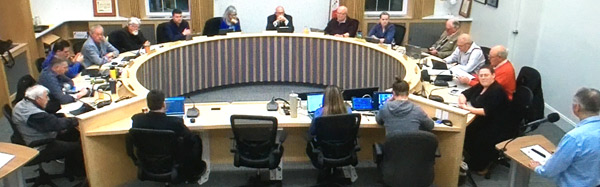
Highlighting the issues surrounding housing and homelessness, the housing department presented an updated report to council Tuesday summarizing the services, activities and funding related to supporting needs.
It was a lengthy and in-depth discussion that ensued around the horseshoe, but what largely came out of the conversations as a huge contributor to the worsening issue is the lack of provincial government funding to address the problem.
“The source of the problem is a lack of resources, so hearing that year-after-year is painful to hear,” said councillor Kate MacNaughton.
There is a long wait for subsidized housing with 520 households (about 1,500 people) on Prince Edward Lennox and Addington Social Services (PELASS) waiting list, with a five to eight year wait.
Scott Robertson, social services manager with PELASS said with the affordable housing crisis, they have been waiting for some kind of affordable housing program from the government that will fund units and initiate the creation of new affordable housing.
“It’s 20 years of failed public policy and this is where we are,” Robertson said. “Things have got tighter, waiting lists have got longer, and I am still waiting to see that moving the needle in a good direction.”
The comprehensive report includes the work of the PELASS committee, as well as highlighting the results of the regional housing summit held last year, and the homelessness enumeration completed earlier this month.
In their report, Elis Ziegler, affordable housing supervisor, explained how homelessness has been increasing in Ontario since the 1980s, when senior levels of government dramatically reduced funding for purpose-built affordable and social housing for both the general and special populations.
The result has been not only an increase in people precariously housed and without shelter, but also an over-reliance on municipalities to fund housing and homelessness solutions, they said.
“As a result of the dramatic increase in encampments by residents throughout the province, exacerbated by the pandemic, the Association of Municipalities of Ontario (AMO) published a report in January 2025: Municipalities under pressure: An update on the human and financial cost of Ontario’s homelessness crisis.”
An update summary by the AMO released in January 2026 showed that not only is homelessness increasing in the province, but it is also not abating, with an eight per cent rise in homeless Ontario residents since the report was released a year ago, with rural communities being no exception.
“Further, the report’s data demonstrates important points with respect to rural homelessness; it is increasing disproportionately in rural areas and municipalities are increasingly funding this downloaded issue.”
The AMO report states that in mostly rural communities, lower population density and smaller tax bases limit the extent to which such support can be addressed through the property tax levy alone. The financial pressures arise primarily as a result of the downloading of major assets and responsibilities to municipalities in the 1990s, a municipal challenge further exacerbated by severe funding constraints in rural areas.
“Even though the province has increased support for rural municipalities through targeted infrastructure, operating and development programs, rural municipalities remain more dependent on property tax revenue, which accounts for approximately 62 per cent of total rural municipal revenues, compared to 54 per cent in urban municipalities,” the AMO report states.
“These figures reinforce the reality that the investment required to respond to sustained homelessness growth exceeds what municipal revenues can provide within the current system design. Even when provincially supported housing and homelessness funding streams are factored in, the system cannot keep up with demand.”
Ziegler said the report boils down to advocacy, and the need to continue aggressively advocating to change policy.
“The cause of homelessness is two-fold: one is that the senior levels of government got out of housing in the ’70s, and the other is that our basic social safety net that was gutted by 22 per cent 25 years ago, and has never been recouped,” shared Ziegler. “Those are two very distinct and clear causes of homelessness that are outside of the scope of the municipality to respond to.”
Mayor Steve Ferguson called it a “gigantic” problem.
Robertson also provided an extensive update on PELASS’ programs and housing and homelessness services and initiatives, where he spoke to the funding formula and funding distribution, as well as outlining the range of services and supports at their disposal.
Managing the local housing corporation (and the centralized wait list) on behalf of Lennox and Addington County and Prince Edward County, PELASS has 115 subsidized units for Prince Edward County which PELASS owns and manages, including Disraeli Street, 16 Lake Street, 113 East Mary Street and Barker Street.
Robertson explained how there are two non-profit housing providers in the County supplying 90 units, with 42 units at Quinte’s Isle non-profit (in the form of one, two and three-bedroom homes), and 48 units at Harmony Homes/Picton seniors (providing apartments).
Councillor Brad Nieman asked what the plan is to get more affordable units in the County given all the units are full and come with a five to eight year wait. “How do we get new units here to alleviate some of that backlog in Prince Edward County?” he asked.
There are many reasons why someone may become homeless, such as the high cost of rental accommodation, mental illness, a job loss, addiction issues, and the end of a relationship.
“About 40 to 50 per cent of people who initially become homeless have an acquired brain injury,” he outlined, “and for someone that has been living on the street for four years, the likelihood is there is a 70 to 80 per cent they have an acquired brain injury.”
He said, they have more than 1,200 people every night that rely on them for an affordable place to stay.
There are 99 people on the by-name list, 33 of those in the County, which identifies the number of people experiencing homelessness who have volunteered to go on the list. And there are many people that do not consent to be on the by-name list or to engage with services, but help is still offered to them.
A recent enumeration completed by PELASS shows, out of 139 unhoused people, 39 are in Prince Edward County. “That’s just what we know, generally the real unhouses are probably three or four times what we see.”
“An unhoused person costs between about $80,000 to $120,000 a year, most of that is consumed in health care costs and judicial costs,” Robertson explained, who said hospital stays are $1,500 to $2,000 a day. “The cost for one supportive housing unit with supports based on a 25-year mortgage is about $28,000 a year – it’s cheaper to build housing and supports for people who are unhoused.”
“PELASS is doing really, really important stuff, vital stuff, urgent stuff, but I often wonder if we are just dealing with band aids here, and whether this is sustainable,” shared councillor Bill Roberts.
“Have we come to a point, as this is accelerating, the band aids are breaking off, they are wearing out, there are not enough of them, its unsustainable… we need to come up with something that is sustainable, we need to be advocates for something other than, give us a bit more money for the band aids,” added Roberts.
“If we spend all our energy administering failed public policy, and failing public policy, are we getting anywhere?” he said. “Maybe we should be advocates to say, this doesn’t work.”
Ziegler’s report explains that with housing and income so interconnected, provincial funds administered by PELASS support income and housing security in critical ways for County residents.
When it comes to administering and analyzing, Ziegler’s report notes that determining the exact extent of homelessness in rural communities is a particular challenge, given Prince Edward County has no warming centres, drop-ins or emergency shelters.
“There is a reliance on temporary accommodation, for example couch surfing, as a means of securing day-to-day shelter,” it states. “Periodic homelessness enumeration is conducted to attempt to estimate the numbers of residents experiencing homelessness.”
During the last week of January and the first week of February, community partners contributed to the enumeration, resulting in raw data to be reported by PELASS, with preliminary count reports that 39 individuals are experiencing homelessness in the County. This is in addition to the 30 people currently registered in the PELASS by-name list program, which is a provincial mechanism to encourage residents experiencing homelessness to be counted, and for which residents can be fast-tracked for social housing and receive other benefits.
Municipal development incentives indicate 390 units of purpose-built affordable rental housing in direct and indirect partnership with the municipality, are at various stages of development in the County. It further notes that Leeward House has moved 11 people out of homelessness since its inception in 2024.
Council received the report and the presentation for information, and staff will continue to work on council-directed activities related to affordable housing and homelessness prevention.
Filed Under: Featured Articles • Local News