


Drake Devonshire’s heritage permit for new addition delayed
Administrator | Jul 28, 2026 | Comments 6
By Sharon Harrison
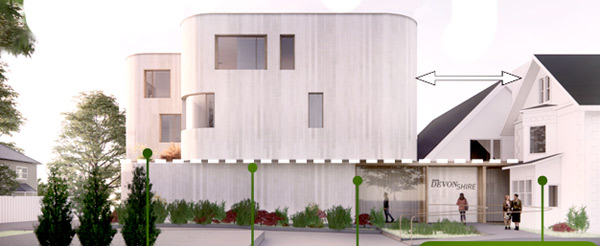
The Drake Devonshire’s proposed expansion in the form of an ultra-modern three-storey addition has long been a bone of contention with some Wellington residents, neighbours, heritage folks and others, with the long-running saga taking some twists and turns during the drawn-out process which has spanned about eight years.
With site plan approval already in place, the decision of allowing the proposed expansion is as close as it’s ever been. What it awaits before any construction can commence is a heritage permit to be issued, and that is at the crux of this latest delay. Its relevance and importance coincides with being the first such application being considered under the new Wellington Heritage Conservation District (HCD) plan.
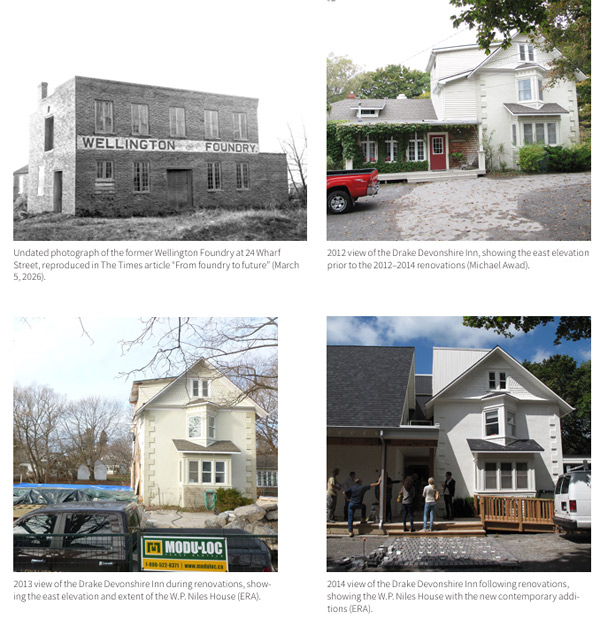 The Drake properties consist of a circa 1906 residence (W.P. Niles house) with 2012-2014 additions at 24 Wharf Street, with a property at 20 Wharf Street which is intended to be removed (to be replaced by the new addition). The proposed development introduces a new three-storey (39 foot) hotel expansion east of the existing Drake Devonshire Inn.
Both properties are designated under the Ontario Heritage Act as part of the Wellington HCD, where the plan identifies 20 Wharf Street as a non-contributing property, and 24 Wharf Street as a contributing property.
At last week’s six-hour council meeting, a good chunk of that time was devoted to this issue. which included a deputation by the Drake’s legal counsel, along with half a dozen comments from members of the public (including the Drake’s closest residential neighbour, local residents, a nearby business, the Wellington Community Association and the Prince Edward Heritage Conservancy).
Up for consideration here was the heritage permit application which the built and cultural heritage (B&CH) advisory committee, at their July 8 meeting, had recommended be deferred until a heritage impact assessment (HIA) is provided by the applicant (at the applicant’s expense).
At the July 8 meeting, it was discussed at length over several hours, at times confusingly, and included hearing several deputations and comments from the public, as well as the applicant’s agent, Philip Evans with ERA Architects Inc. who provided a presentation. It is a requirement under the Ontario Heritage Act that heritage permit applications go before a heritage advisory committee for consideration and opinion.
The committee had also recommended a scoped HIA to be undertaken by a third-party heritage consultant to identify architectural character-defining attributes of the Wellington HCD, based on the study and plan.
However, council did not agree with the proposed recommendation by the B&CH committee, instead voting 7-5 in a recorded vote to approve a new referral motion put forward by Wellington councillor Corey Engelsdorfer.
Councillors David Harrison, Sam Branderhorst, Corey Engelsdorfer, Janice Maynard, Roy Pennell, Phil St-Jean and mayor Steve Ferguson voted in favour (Bill Roberts and Phil Prinzen were absent).
Engelsdorfer’s motion recommends that the heritage permit application be referred to staff to continue to work collaboratively with the applicant towards an outcome that supports local business investment, while honouring the character of the Wellington HCD plan. It is expected to come back to council with a recommendation at the Aug. 25 council meeting.
“It’s not a choice between supporting the Drake or supporting heritage because I believe we can and we should do both of those things,” said Engelsdorfer. “The Drake’s made significant investment in Wellington and it’s contributed to our local economy. At the same time. Wellington’s HCD exists for a reason, so whether we agree with it or not, it exists. It was created to guide change in a way that respects the character of our community.”
He said from the discussion at the heritage meeting, it’s clear that there is still some concerns about whether this proposal fully aligns with the intent of the HCD plan.
“I don’t think those concerns should be simply set aside,” expressed Engelsdorfer, “If we are prepared to approve tonight without taking time to address those issues, then we have to ask ourselves what the purpose of the HCD really is.”
Because referral motions supersede deferral motions, and in this case the referral motion passed, the original motion to defer was not voted upon.
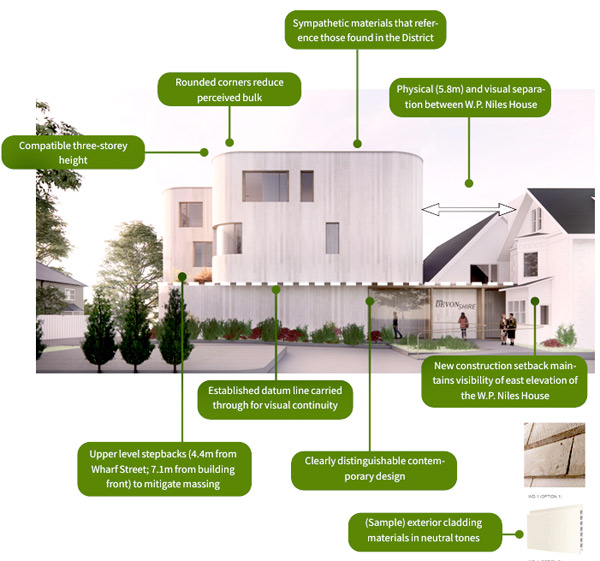 The Drake’s legal counsel, David Bronskill with Goodmans LLP, spoke to why the heritage permit for the proposed extension is so important, noting how they have the full support of the Wellington Community Association, as well as conditional support from the planning department.
“It’s frankly a modest three-storey proposal, it is of a more modern vernacular, but frankly that’s a clearly distinguishable contemporary design which is frankly desirable from a heritage perspective,” said Bronskill. “… included rounded corners to reduce the perceived bulk and exterior cladding in neutral tones that’s in-keeping with the surrounding area. Frankly, I think, a very attractive and desirable extension.”
Addie Pierson, owner of Wellington Foodland, has long battled the Drake where she shared a brief overview of a long list of issues encountered over the last five years, particularly as it relates to parking, but also the operating impacts to the grocery store.
“…the decision will set precedents for years to come. Yes, we can see it’s vastly over-sized and will forever change the look of the downtown core of Wellington, that should be obvious to all who look at the diagram,” shared Pierson. “One business trying to expand cannot disable another business’s ability to operate.”
Liz Driver, Prince Edward Heritage Conservancy president, said she was in support of the B&CH committee recommendation to defer the permit until a third-party independent scoped HIA was completed, explaining why that was important.
“Council should consider the permit application carefully with complete and objective information, and respecting the committee’s advice. Instead, the owner’s lawyer is asking council to reject the recommendation of its own statutory committee and rely on the “extensive work on Canada’s most reputable heritage firm”,” explained Driver. “Now, this would be appropriate if ERA architects were working on behalf of the County, but in this instance, they are the consultants to a private owner. And they are applying a narrow interpretation of the Wellington HCD plan to their client’s advantage, without regard to the plan’s spirit and intent.”
She said there has been no collaboration on the building design “which is the nub of the issue”, and she said the owner has held no pubic meetings, has made virtually no changes to the design, and released the drawings for the heritage permit with virtually no changes, at the last minute.
Sounding exasperated by the whole process, Richard Elliott (and his wife Lourdes DeCosta) whose property is closest to the proposed Drake extension, and will be the most affected by the new addition, have battled this issue for many years, where they once again reiterated their point and concerns, where the height, mass and scale of the proposed addition were foremost.
“New construction must respect and maintain the façade height of its adjacent buildings, “adjacent” is specifically defined to include the buildings on both sides of the street because it’s focused on the streetscape,” explained Elliott, “It’s too big relative to the existing buildings and the streetscape.”
“We are the ones that live with this problem on the south end of Wharf Street and we want it over. This is wildly inconsistent with the heritage act,” expressed Elliott. “If this council and Wellington wants the heritage plan, then apply it. If you don’t, if you think this sort of a building is a good thing, get rid of the heritage plan and we will support that. This is a fundamental inconsistency here, and we just want the same rules to apply to everyone.”
John Caliendo with the Wellington Community Association stated that nine of the 11 steering group members support the permit application. “Recognize when you had a win, and this is a win in my experience,” said Caliendo.
Councillor John Hirsch, who also sits on the B&CH committee, provided some background on the July 8 B&CH committee meeting and how they arrived at this point, explaining that in April 2025 (well over a year ago), the committee was asked to look at the site plan documents, and in so doing started to have heritage concerns.
“Shortly thereafter in May 2025, as vice-chair of the committee, I was asked to meet with the owner of the Drake who wanted to know what they could do about these objections. I strongly urged them to have an independent HIA done, and to file their application for a permit.”
He said no application was filed until May 21 of this year, and no HIA was done.
“A June 11 memo to Mr. Evans (consultant to the Drake) was provided to heritage advisory committee to make its comments on, with five days notice in advance of our July 8 meeting, hardly enough time,” expressed Hirsch. “Nevertheless, the permit task team did a review, concluding that there are two very different schools of thought.”
“They concluded they have a very different way of looking at this than the applicant’s consultant does. And so, the best approach to deal with this would be to get an independent opinion to do a HIA on a scoped basis to come up with some recommendations.“
That is the motion council has to consider tonight said Hirsch, who said the HIA has to get done by Sept. 15, which is the 90-day deadline, “and that the Drake has indicated they are not prepared to budge on that date, which is unfortunate”.
Hirsch pointed out that the Ontario Heritage Act doesn’t just say 90 days, it says, “or at some later date as agreed by the parties”.
“Is the Drake willing to consider perhaps a month’s extension? asked Hirsch, “and the reason I ask for that is, the heritage advisory committee had very little time to review this application, the materials were only provided to it only about five days before its July 8 meeting… there have been so many questions, and it has not been able to come with a recommendation to this council.”
He said the permit task team is looking for an independent scoped HIA, not a full blown HIA, something he said could be completed by the end of September. He further reminded that the information provided by Mr. Evans in on behalf of the proponent, and is not an independent source.
Bronskill said he does not have instructions to accept any type of extension of the 90-day period, confirming also that the Drake are not prepared to pay for a HIA.
“I have to flat out disagree that ERA and Evans are not independent – they have a code of ethics, both as architects and as cultural heritage consultants, to provide their independent advices,” stated Bronskill. “It is an independent assessment, and it is by one of Canada’s most reputable cultural heritage architectural firms.”
Councillor Roy Pennell took issue with the Drake’s unwillingness to consider an extension of time.
“The fact that you were not ready to at least consider extending that by 30 days, I find that almost unconscionable that a business such as yours would not be willing to work with the County for 30 days. And to outright say no, I find it offensive.”
Bronskill responded by indicating that, “the first time they were asked the question on whether they were prepared to extend by 30 days was about five to 10 minutes ago.”
It was confirmed by Cristal Laanstra, director of development services, that the Drake could only go to tribunal after Sept. 15. Bronskill clarified that the relevance of this date comes from the commencement of a 90-day period that began on June 15 when the last documents were filed with the County. The County must make its decision by Sept. 15 to avoid a legal route.
Councillor Chris Braney said he didn’t see any difficulty with the three parties having a conversation about finding a way forward, so that there is some fairness across the board.
“The dilemma I am faced with, this is our first file under this new heritage model or designation. Look at the difficulty we are having around the table,” expressed Braney. “The problem I am having is that planning had approved this file. The applicant has put unlimited resources into going through the hoops that were required of them to go through.“
Braney went on expressing his overall concerns to the process, and suggested the HCD plan may need to be further “fine tuned”.
“It appears to me that there are still some serious wrinkles with that heritage plan and this is why we are faced with this dilemma,” he said. “I am also concerned that our heritage committee may not have… they appear to be confused and I am concerned about that. “
Hirsch reminded again that this is the first case being considered under the Wellington HCD, and it needs to be done right.
“What bothers me is, the applicant knew well over a year ago that they needed to file a heritage permit, and this is to do with whether it complies with the Wellington HCD plan, and they didn’t file that application until just a couple of months ago,” expressed Hirsch.
“Our committee has looked at this in their submission regarding heritage (nothing else), it’s simply whether it is compliant with the HCD, and that is required under the law, and council has to ask its opinion, and the committee has said it needs more information to do that.”
Referencing the deputation made by the Drake’s counsel, mayor Steve Ferguson said, “sabre rattling about going for a review, which isn’t good for anybody, which would likely yield the result of this going back to one of the original iterations of the development”.
“Standing in the way of development, of progress in our communities, does nothing to help the municipality,” he added.
Documentation relating to the Drake Devonshire’s heritage permit application, as discussed at the July 21 council meeting can be found on the corresponding agenda items for the July 8 Built and Cultural Heritage Advisory Committee meeting on the County’s website, along the with meeting recordings.
Filed Under: Featured Articles • Local News



































I am all for older buildings with a modern attachment. For the most part they can be quite beautiful. Clearly they can do better.
If the Washburn Building hadn’t been willfully allowed to deteriorate by previous Councils, as so many buildings are allowed to do so around here, it wouldn’t have had to be demolished.
That building is, quite frankly, an ugly, cheap looking box. I appreciate creating a modern contrast but the addition should have some merit of its own.
I’m not seeing anything remotely connected to a design that would say the Drake is respecting heritage architecture of Wellington. They do know better. This is like dropping an alien spaceship into the area. Please redesign this so it fits the designation, and not some architects abstract idea of what heritage is. Dali anyone?
Washburn Building wasn’t worth saving. Who was going to pay to totally renovate that at enormous cost?
As a heritage advocate in PEC since 1984, I am not at all surprised that County Council did not accept the advice of their own Built and Cultural Heritage Advisory Committee. It is a pattern I have witnessed repeated over and over again, including when an HIA was advised for the Washburn Building (next to Shire Hall) before it was demolished TWENTY years ago. Plus ca change.