


Heated discussion over pay; council rejects review report
Administrator | May 18, 2026 | Comments 2

By Sharon Harrison
A report providing results of a council compensation review and policy update, specifically a council remuneration review, was not well received by council at last week’s committee of the whole meeting.
Numerous councillors voiced opinion on the topic, and while some expressed concern that councillor salaries should be increased, a few did not agree. The consultant’s report, and staff’s recommendation, is for no changes to be made the council compensation package.
The review of council compensation was undertaken by consultancy firm Stratford Group (cost around $10,000) who conducted an independent council remuneration review, including comparator analysis, assessment of workload and time commitment, review of compensation structures, and market practices related to council remuneration and expenses.
The review is a policy requirement which requires a review be done in the third year of a council term, whose purpose is “to make sure our compensation policy aligns with our comparators and market best practice”, said Arryn McNichol, Director of Finance and Information Technology.
Council expressed general dissatisfaction and disappointment with the report, concerns about the data used to compile it, and general agreement that more work needs to be done. It was also noted by several councillors that the Stratford Group were not present to present the review, nor available to answer questions.
While deliberations made for interesting discussion, emotions got the better of a few, as several personal insults and accusations were delivered, and conduct quickly got out of hand with raised voices and argument before calm was restored after a time-out.
A referral motion by mayor Steve Ferguson passed which will see the report go back to staff to investigate and provide more data on the compensation component, as well as report back on barriers to council member participation and ways to address them.
“More work needs to be done concerning the compensation for council members. It’s a disservice to our residents to not pay people appropriately for the amount of time they are going to have to commit to working as a member of council,” shared Ferguson.
“I’d like to see that salary level for council members assessed with more data acquired from other municipalities or other research before we move anything forward at this point. We’ve got to make this right for the next council.”
Councillor Phil St-Jean had concerns at the relevance and quality of the data.
“Compensation should be a little higher, yes. Stratford didn’t provide enough valid data to definitively say what that should be, so I am struggling with having data I can support,” said St-Jean. “I believe that we are under-compensated for all the very good reasons shared here today, particularly when it comes to equity of accessibility.”
A key theme emerging from the survey was that many members experience the council role as a significant or near full-time commitment when accounting for meeting preparation, constituent engagement, committee responsibilities and issue complexity, notes the report.
“Stratford noted this perception of workload was higher than what was identified through the broader comparator market survey.”
The review found the County’s current compensation framework remains generally aligned with comparable municipalities, stated the report.
McNichol noted that the comparator review included a mix of Ontario municipalities considered reasonably comparable to Prince Edward County, based on factors such as population, tourism activity, geographic scope, service delivery responsibilities and governance structure. They included both single-tier and upper-/lower-tier municipalities to provide a broader view of council remuneration practices across similar sized and service-oriented communities.
Twenty invitations went out to different municipalities, with only 13 responding, including the Municipality of Port Hope, Town of Collingwood, Huron County, City of Kawartha Lakes, Municipality of West Nipissing, City of Quinte West, United Counties of Leeds and Grenville, Town of Niagara-on-the-Lake, United Counties of Stormont, Dundas and Glengarry, Township of Uxbridge, Town of Cobourg, Town of the Blue Mountains, and County of Grey.
McNichol commented that if they had had more participation, they would have had better data. “All municipalities are very, very busy, and unfortunately we were maybe rushing to get some of this information into council.”
“The review found current council remuneration is generally positioned around the median of comparator municipalities and that the County’s annual salary model is consistent with the approach used by most comparators.”
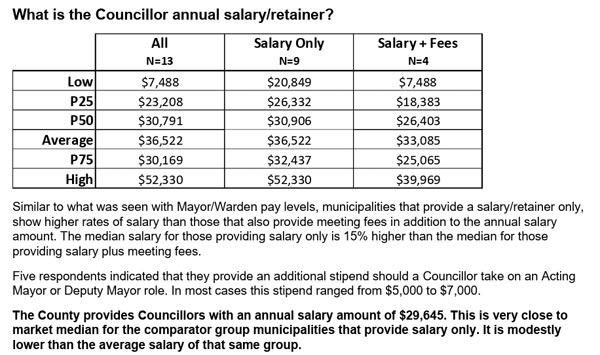
Overall, the council remuneration program at Prince Edward County is “typical, competitive, and appropriate” when compared with the 13 municipalities that provided data about their programs, the review showed. “The County provides remuneration mostly in the form of an annual salary/retainer that falls close to the median of the full comparator group for both the mayor and councillors.”

But many around the horseshoe did not agree and questioned using upper- and lower-tier municipalities as comparators as not aligning with Prince Edward County (being a single-tier municipality).
The review also considered workload and scope of responsibilities and found Prince Edward County’s council responsibilities to be generally comparable to peer municipalities, while recognizing that time commitments can vary among individual members, noted McNichol.
Reimbursable expenses, professional development support and the health care spending account were also found to be generally aligned with comparator practices.
To supplement the market review and inform the scope-of-work component of the study, council members were invited to participate in a confidential council remuneration survey as it relates to workload, compensation philosophy, survey, supports and expense provisions, and member perspectives on the council role.
Only nine of 14 council members completed the survey, it was noted.
Survey feedback also identified concerns that some aspects of the role, including preparation, due diligence and constituent responsibilities occurring outside formal meetings, may not be fully reflected in the current compensation structure.
“Several comments also referenced accessibility considerations, and the potential impact compensation may have on who is able to serve in elected office,” said McNichol. “While the survey results are qualitative, Stratford concluded the feedback provides useful local context when considering council compensation relative to the broader comparator market.”
“I am hearing that we haven’t been provided enough information,” said Nieman. “That group asked for comments from all of council, so hopefully all of council submitted which we know they didn’t. They can’t get information is nobody fills out the survey. Not all of council filled it out.“
Councillor Sam Branderhorst called the information “skewed”.
“I think it’s tricky when two of the comparators were over 100,000 people, and three more are 50,000-99,000, so they’re not really near us; six were lower-tier, only three were single-tier,” expressed Branderhorst. “It’s hard to find a good comparator for us, but it also makes the conversation really hard when Stratford isn’t here: we are talking about our work, our value and our community, and equity inclusion and accessibility, and they are not here to talk about that.”
Developing comparators is a very difficult science as each municipality is very unique,” explained McNichol. “Finding a comparator similar to Prince Edward County is very difficult. Stratford felt that it was representative with the survey.”
Councillor John Hirsch expressed “disappointment” in Stratford’s report, adding how they are not present to defend it. He said it is too full of medians and averages and not specifics about the municipality, with not enough focus on the responsibilities of a single-tier municipality.
“There is a huge difference between upper-tier, lower-tier and single-tier; we have all the responsibilities, those other tiers have half each,” expressed Hirsch. “I would have liked to see more focus on the responsibilities increasing of single-tier municipalities.”
Hirsch noted some councillor salaries in some of the comparator areas, such as Kawartha Lakes, population 83,000, single-tier municipality, salary $55,000 a year – we are at $29,000, he said. Port Hope, population 18,000, lower-tier municipality, salary $46,500; Collingwood, population 29,000 (similar to PEC), salary $29,000 (same as PEC), but only a lower-tier municipality; Cobourg, lower-tier municipality, lower population than PEC, salary $40,231.
“I would have rather seen more analysis of what a single-tier municipality councillor’s salary should be verses the upper- or lower-tier,” expressed Hirsch. “My interest is in this equity of access concept, we really need to do something to attract more people to run for council, and a significant increase in salaries would be one of them.”
Councillor Kate MacNaughton said it is not the right report and is not what was assigned.
“Knowing what that number is is important, knowing who is shut out is important. A majority did respond [to the survey] and a large majority of the respondents said the work is very consuming, and it is full-time or close to full-time, and it is undercompensated.”
She said, the last time this came up, there were people around the table who said, ‘I would do it for free’. “Of course, everyone here who loves their community would do it for free, but I can’t afford to because it is an all-consuming full-time job.”
She said she found the report to be pretty “lack lustre” and took issue with the comparator not being broken up into categories. “There are lower-tier comparators that are earning more than we are, but they are all averaged in; they should not have been averaged in.”
The overall impact on a municipality is not a ton more money, it is very small increase to the levy, but it can be met with additional quality for the voters of the municipality, she said.
“This is work that consumes your entire life, it consumes your thoughts, it can take you away from your family, it can interrupt your daily life if there are crises, all of those considerations are important,” shared MacNaughton.
Councillor Roy Pennell said he would suggest the amount of hours anyone puts in is a fair amount.
“It’s still $30,000 minimum, 72 cents a kilometre for mileage, extra pay if we chair a meeting, I do not think, if we are doing a job, there has got to be some compassion there that you are helping out your community,” expressed Pennell.
“What happened to the fact that you do a job because you want to help out your fellow community, your citizens, your family,” he continued. “I am sure not as hell here for the money. I am starting to get a little fed up with all the people, ‘more money, more money, more money, to me, to me’.”
In response, MacNaughton called a point of privilege.
“Councillor Pennell, what you’ve said is, I sit here because I am greedy. That is not the case. When we are talking about access to the job, it is because you have a pension and you have an alternate source of income. I tried to continue my job to make it a part-time job, but was not reliable, so I gave up,” expressed MacNaughton. “This job is an encompassing job. Nobody is saying I want to make money off my community, I am trying to steal from my community for my own self, I am just trying to live my life.”
“When you say it’s just me being greedy, it’s me saying, we need people at this table who don’t have other sources of income. It is not greed. I am only able to participate here because I am willing to impact my family with my lower income,” stated an emotional MacNaughton.
While Pennell apologized to MacNaughton, he said he still stands by what he said.
“I don’t think the chair (MacNaughton) should be advocating against the difference of opinion,” chimed councillor David Harrison, who called a point of order.
“In this case, he was making a claim that was insulting, it was not because he had a difference of opinion, it was the insult buried in the opinion,” MacNaughton added.
“If you are insulted, maybe you should look at another job,” countered Harrison.
Amid the heckling and multiple councillors talking over one another, things got a little heated and out of control before councillor Brad Nieman intervened to ask the clerk or the CAO to calm the situation, which resolved after a brief recess.
All decisions made at this meeting will come back to council on May 26 for ratification.
The staff report, as well as the consultant’s remuneration review, discussed at the May 14 committee of the whole meeting can be found on the corresponding agenda on the County’s website, along the meeting recording.
Filed Under: Featured Articles


































WE paid this consultancy group, Stratford Group, $10,000 of taxpayer money? And yet, they were absent from this meeting to explain their findings to Council. Why were they absent? This meeting should have been held over until this Consultant was present and accounted for.
We get what we pay for.