


High levels of phosphates in Bloomfield’s Mill Pond Park
Administrator | Sep 30, 2026 | Comments 0
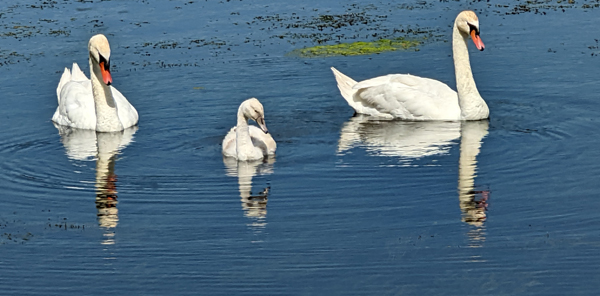
Swans on Bloomfield Mill Pond. – Sue Capon photo
By Sharon Harrison
The water quality of the Mill Pond in Bloomfield was the focus of a recent public meeting where Quinte Conservation provided an update on water testing. Residents learned what’s exactly in the water, and why the health of the pond hasn’t appeared good for some while.
Results of the first year (of two years) water testing and analysis has revealed that the pond has very high levels of phosphates, showing “several extremely high levels”. Provincial guidelines show that in order to avoid excessive plant algae growth, phosphorus needs to be below 30 megagrams per litre while the pond showed several indications of extremely high phosphorus levels above 100.
The main culprit, in large part, was stated to likely be fertilizer used on the many large residential urban lawns and gardens that sweep down to the pond’s edge.
About two dozen residents came out to the Bloomfield Town Hall to hear the project update and the results of water testing to date, where Kaitlin Mauer, environmental monitoring lead with Quinte Conversation, provided a technical and informative presentation on the pond’s water health.
 “One of the main sources of phosphorus in the environment, especially in rural environments, is fertilizer from agriculture and urban sources, so that includes any kind of fertilizer that you are putting on plants and on lawns, and all that is going to enter the water at some point.”
She said sometimes too much fertilizer is applied where the plants don’t absorb it and the run-off ends up eventually in the water, but admitted that it is not easy to pinpoint exact cause. Other sources of phosphorus include wood ash (people burning wood), manure (including dog manure), milkhouse wash water and leaking septic systems.
Service water samples were collected at different areas for eight months in 2025 and then again in 2026, also taking samples at other nearby streams for comparison purposes, as well as further downstream.
Mauer noted that water sampling and testing by Quinte Conservation, which is standardized across the board so as to not affect the quality of the sampling, has been going on in Prince Edward County since the 1960s so they have a lot of established data generally.
She explained that to look at the health of the pond, they have to look at all the nutrients coming into the pond because that ultimately is going to determine what is going on in the pond in terms of algae, plants, animals (bird, fish), etc.
While they tested for several different things, such as nitrogen, nitrates and nitrites, ammonia (un-ionized and ionized), oxygen and connectivity and conductivity levels among them, most results were in the normal range. Except for phosphorus.
“The amount of phosphorus determines how much plant and algae can grow and that’s mainly the first thing that is going to be impacting the rest of that system,” Mauer explained. “Increased phosphorus equals increased plant and algae biomass, increased plant and algae biomass means more photosynthesizing, but also respiration, so while it produces oxygen, it also consumes oxygen.”
She said that when those plants and algae die off, they also consume oxygen, so low oxygen can be detrimental to things like fish, so if there’s too much plants and algae in the water, it can almost lead to fish kills when there are really high amounts of respiration going on.
“At every single site sampled, the average across the year was above that guideline, so all the water entering the pond and then leaving the pond is above the guideline to eliminate excessive plant and algae growth,” outlined Mauer.
She indicated that if all the algae growth was removed, it would just come right back as there is too much nutrients entering the system. She also noted how there are trends where it builds in the rainy season for example, but pointed out that generally across the board there is more phosphorus entering the pond than leaving the pond.
“This can be a concern when the pond has so much algae in it, and so much plants, and it is storing the phosphorus, and there is more phosphorus than needed, so then it drops to the sediment and then situations where the oxygen is slow, that sediment can release the phosphorus.”
She said this is a problem primarily found across all watersheds, especially across the Bay of Quinte where it has been a problem for decades because there are a lot of nutrients entering the system and there are a lot of different sources, as well as land use upstream.
“Essentially, once you have too much phosphorus in the system, it binds to that sediment, you are looking at long-term remediation. So, just by removing the input, it doesn’t mean that it disappears immediately, sometimes it takes a few years of low input to get back to a natural state.”
 The provincial guidelines show that in order to avoid excessive plant algae growth, phosphorus needs to be below 30 megagrams per litre. She indicated there were also several indications of the hyper-eutrophic state, so extremely high phosphorus levels above 100.
“Those increased levels provide increased risk of cyanobacteria producing algae which can be toxic to humans and livestock and fish and things like that. There are just a couple cases of where that occurred, but it did occur at every single site sampled at some point in time.”
Several audience members asked what they can do differently to help improve the situation, and what alternatives there are to fertilizing a lawn and how to prevent run-off into the pond, where Mauer outlined some of the actions people can take, and the funding that is available.
She suggested better controlled use of lawn and plant fertilizing, including getting soil tested to establish nitrogen and phosphorus levels – she indicated many people often use too much fertilizer which the ground cannot absorb. Also, installing a rain garden, planting vegetation, a garden and/or trees near the water’s edge, using targeted plantings (such as native grasses), where deep-rooted plants were preferable to shallow-rooted plantings.
The idea is to divert all the run-off and so the appropriate vegetation would be helpful to reducing the amount of water that is running through the grass, and into the pond.
A 30-metre buffer is recommended generally, although not necessarily realistic for some, she noted, where she suggested starting with a one-metre vegetative buffer, and building from that, indicating that any progress towards that will improve the situation.
A question session followed with audience members appreciative of the information where Sarah Soetens with the Mill Pond Park steering committee said a lot of good information was provided, and they can talk about what it means and where to go from here at future meetings.
She noted that the project goal originally was to help make the mill pond, and its biodiverse eco-system, accessible to all.

– New fence line at Bloomfield’s Mill Pond Park. Sue Capon photo
“There was a step to get up into the park, it was not accessible, there were benches that were falling apart, the pathway was overgrown, there was fence lines with the neighbours that were unclear in how you got around it,” she shared.
Council voted to designate it as project of community interest in May 2025, after a public meeting in June 2024 where Soetens said that meeting provided insight into what matters for Bloomfield residents. Making the project one of community interest allows the group to fundraise and get access to funds and in-kind services that would otherwise not be available to them.

One of several painted benches at Bloomfield’s Mill Pond Park
“We were able to raise $80,000 and we re-did the path, we cleared up the theatre, the washrooms, the benches, and we re-surfaced the path all the way around.”
She noted that the original scope of the project included other spaces where they wanted to look at parts of the cemetery and other parts of the mill pond, but she said once the group met, it became very clear that the ecology of the pond was of major concern to almost everybody.
“There was a lot of discussion around the algae, around the bio-diversity and the summarized response was, yes, make it accessible, but make sure you also figure out what’s going on with the pond.”
Some of the raised funds were put to two years of water testing.
“The goals of the project expanded from eco-logical environmental stewardship, improved access to the recreational space, and heritage awareness and education.”
Filed Under: Featured Articles • Local News