


Municipal support for proposed South Shore dark sky preserve
Administrator | Aug 27, 2026 | Comments 0
By Sharon Harrison
Prince Edward County’s proposed Dark Sky Preserve took a step further in its development at Thursday’s committee of the whole meeting, with council voting to approve exploration of municipal support options.
Staff will work with the South Shore Joint Initiative (SSJI) to establish a Memorandum of Understanding regarding the use of the Mariners Park Museum lands (on County Road 13 in Milford) for astronomy-related programming, public education and dark sky viewing activities.
A letter of support from the mayor will be provided for the SSJI and the Royal Astronomical Society of Canada (RASC) in support of their efforts to pursue a Dark Sky Preserve designation along Prince Edward County’s South Shore.
Staff will also develop a dark sky policy aligned with the principles of the Canadian Guidelines for Outdoor Lighting, for consideration by council at a future meeting. All of the above is expected to be ratified at the Sept. 8 council meeting.
A Dark Sky Preserve is a protected area that works to keep the night sky naturally dark by reducing light pollution, using responsible outdoor lighting, and providing public education and outreach programs. RASC manages Canada’s Dark Sky Preserve program and to receive a designation, applicants must meet several requirements, including following the Canadian Guidelines for Outdoor Lighting, providing public education and working with nearby municipalities and community partners.
At council’s request, staff had been directed last October to explore opportunities for municipal support and report back with recommendations. They reviewed the RASC Dark Sky Preserve application requirements, consulted with municipal departments and examined approaches used by other municipalities supporting similar initiatives.
The goal is to help protect the night sky and reduce the effects of light pollution on the natural environment.
Cheryl Anderson, SSJI president, was in support of the staff report.
“Key to the recommendations of the report is the assertion that the municipality will not immediately have to make any big changes,” noted Anderson. “The process to establish a dark sky preserve on the South Shore will be achieved through community education and development of a dark sky policy, and may take several years.”
Being led by SSJI and RASC, the proposed preserve will not be managed or operated by the municipality, but the County has been asked to consider ways it could support the project through policies, partnerships and municipal operations.
“The review found that the municipality can support the project through a combination of partnership, education and gradual improvements to municipally-managed lighting without requiring significant costs or changes for existing residents and property owners,” noted Kiydan Zachariah, programs and services assistant, in the report.
Staff noted only the cost of a switch ($500-$1,000) to be installed to turn off the lighthouse beacon at Mariners Park Museum during astronomy events, and this will be considered as part of the 2027 operating budget process.
“The proposed Dark Sky Preserve should be viewed as a long-term initiative as the sky does not currently meet the requirements for designation.”
Project partners have also identified a potential nocturnal sanctuary designation as an interim step while work continues toward the long-term goal of a Dark Sky Preserve.
“A nocturnal sanctuary focuses on the protection of the nocturnal environment and natural eco-systems and does not require the same night sky conditions as a Dark Sky Preserve. Because much of the South Shore already contains protected and conservation lands, proponents have indicated that this designation may be achievable sooner while work continues toward improving night sky conditions and pursuing a future Dark Sky Preserve designation.”
The recommendations presented represent practical first steps that could help support future designation efforts while minimizing impacts on municipal operations and budgets.
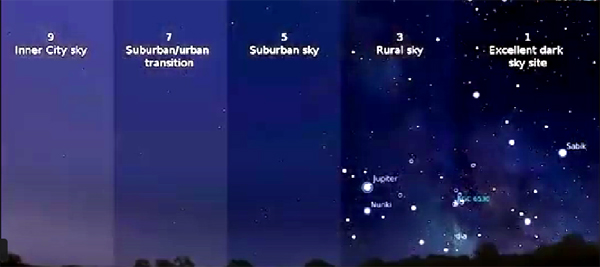
However, SSJI and RASC indicate the South Shore once classified as a Bortle Class 2 dark sky area is now considered Bortle Class 3. The Bortle Scale is used to measure how dark the night sky is, with lower numbers indicating darker skies and less light pollution.
 Before a Dark Sky Preserve application can move forward, the area must return to a Bortle Class 2 rating.
“This means that designation is not expected in the near future,” Zachariah said. “Achieving the conditions needed for designation will require on-going work by community partners, residents, and supporting organizations… project proponents indicated that this process could take several years, and potentially a decade or more.”
Staff learned that supporting a Dark Sky Preserve does not require strict enforcement or major changes for residents.
“For this reason, staff recommend developing a dark sky policy rather than an outdoor lighting bylaw,” explained Zachariah. “A policy would focus on education, awareness and municipally-owned lighting, without creating enforceable requirements for existing residents or businesses.”
The South Shore is recognized as a Key Biodiversity Area and contains important habitat for a wide range of plants and animals. It is also an important migration corridor for birds and bats and is one of the last largely undeveloped stretches of shoreline along the north shore of Lake Ontario.
“Artificial light at night can affect wildlife behavior, migration patterns and natural eco-systems. As a result, reducing light pollution is viewed by project proponents as an important way to help protect the ecological value of the South Shore,” stated Zachariah
“In addition to environmental benefits, protecting dark skies can help preserve cultural heritage and public access to the night sky. For thousands of years, people have used the stars for navigation, storytelling, education, and cultural traditions. Reducing light pollution helps ensure future generations can continue to experience and learn from the natural night sky.”

Filed Under: Featured Articles • News from Everywhere Else