


Queer elders speak in Quilted – the progression of rights through decades
Administrator | Aug 16, 2026 | Comments 0
“Eight hours a day.
Twenty days.
Nineteen new quilts.
Eleven quilted banners.
Two hundred quotes from interviews with Queer elders/seniors.
A thousand visitors.
So many thoughts and emotions flooding over me right now.
I need some time to let this all sink in.
But to all who supported and encouraged me as this project grew …
THANK YOU from the bottom of my heart!
Without the support of community this project would never have happened. I love you all.”
– Bill Stearman on social media on the last day of his latest exhibition.
Story and photos by Sharon Harrison
A gallery of quilts and banners, each thoughtfully and carefully created, presented and displayed, each poignant in meaning and theme, each representing a different event of often national change, moments in time, are all significant as they tell of a time in Canada’s history and are a collective voice of Queer elders who lived through decades of the advancement of their rights.
For quiltivist and County resident Bill Stearman (quiltivism is social activism through quilt making), a regular quilt – whether intended as a bed covering or a throw, or a display piece to hang upon a wall – isn’t always just a quilt in his world. Instead, they can act simply, yet importantly, as the chosen canvas, not intended to distract, but allowing words within to flow, for the message to translate seamlessly.

Quiltivist Bill Stearman at his most recent exhibition
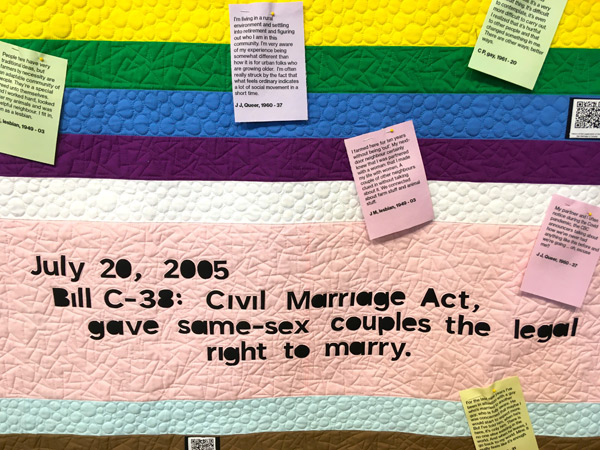
Pinned to many of the quilts are snippets of interviews in the form of short notes conveying a range of fears and lost dreams, words and phrases, and emotions gathered from conversations with more than 65 queer elders Stearman had as he travelled across Canada.
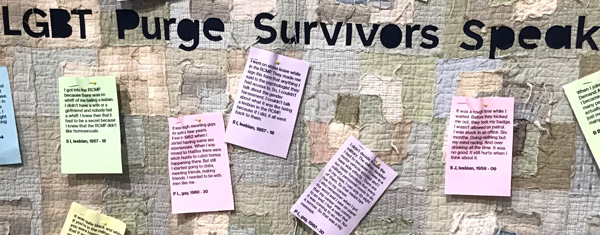 Moving and profound, they are shared experiences, often previously unheard voices, some raw, some funny, some sad. Tangible messages shared about love, hurt, lost opportunities, betrayal, resilience too, but also faith and hope.
“Last year was my 75th birthday and I decided I would travel across Canada talking about my activism with quilts, so I talked, and I did 41 presentations; 10 provinces, two territories and interviewed 67 queer elders,” shared Stearman. “That’s my obsession with losing our stories when we’re gone.”
After his travels, he came home and sorted those stories into 19 quilts that are based on Supreme Court decisions, legislative Acts of Parliament, and historical moments relevant to the Queer community.
“I wanted it to read as one collective voice, rather than 67 individual stories, so I left out names; comments are identified by initials, year of birth and how an individual identifies.”
Finding queer elders to talk to was the hardest part, he said, as he didn’t set out on his journey knowing who exactly he would be conversing with. It was a process that consumed many hours every day and required a lot of organization. He used contacts, who put him in touch with other contacts, connections were made, he reached out to queer groups, did internet searches, and it gradually came together.
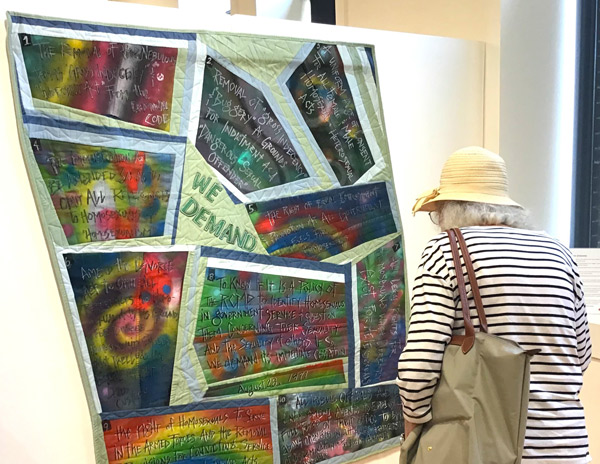
‘Quilted: The Progression of our Rights – Queer Elders Speak’, is the culmination of a journey Stearman took where he began gathering information, thoughts and stories for this latest project. To help provide historical context, there are a number of banners accompanying throughout to help with visual interpretation that depict significant news or world events, to allow for better understanding, events people may remember at a given point in time.
Several years in the making, the free admission exhibition held at The Armoury in Picton wrapped-up last week, and is described as an art show, quilt exhibit, storytelling event, history presentation and mini film festival. Stearman reminds he is a quilt maker, not so much a quilter – crediting Deanna Gaudaur for putting all his quilts together.
It included a daily tour where he shared stories along the way, often of an individual’s personal experiences that clearly had stuck in his mind. He openly shared detail after detail, story after story, explaining layer by layer the hard-fought achievements. Providing a wealth of vivid detail, they portray how life was like for many queer folk and what they endured, especially in the 1940s, 1950s and 1960s, but also through the ‘70s and ‘80s.

“I was a school teacher and I couldn’t be out, because I wouldn’t have had a job, but that’s the mindset that was there,” expressed Stearman. “It was quite a horrendous time”.
The quilts highlight specific dates in history, Ontario Court of Appeal decisions, Supreme Court of Canada decisions, private members’ bills, amendments to the Charter of Rights and Freedoms and much more, each carefully documented within the fabric of the quilts. The tour explained in frank detail what each quilt represents, sharing highlights of the many significant legislative milestones, court decisions and act amendments toward the advancement of rights for queers in Canada.
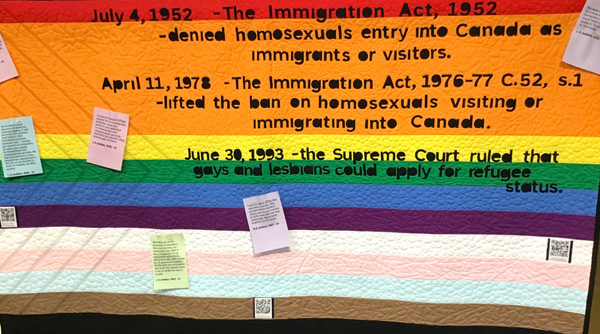
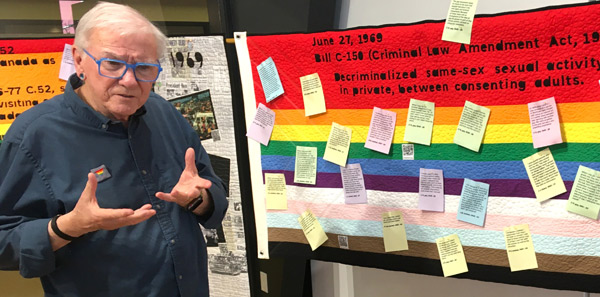
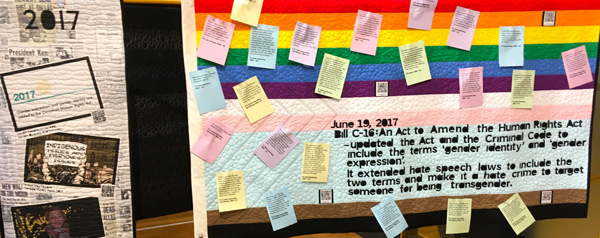
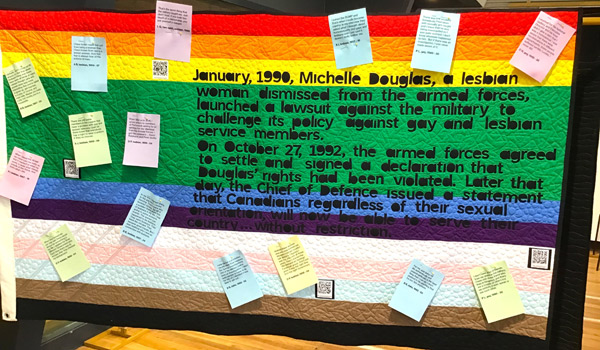
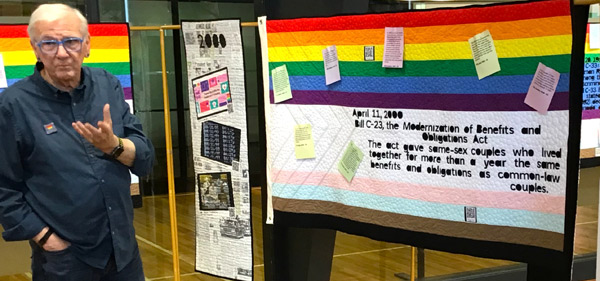
The intention goes beyond the fabric used in the process or the thread holding it all together, where Stearman has found a way to use his voice, and the voice of the broader elder Queer community, to weave that message, to deliver thoughts, telegraph important points, convey an oft forgotten history. And to remember, even when remembering and recollection is painful.
Above all, it is to teach and educate, and ensure no one is forgotten – to ensure history and the Queer community are not forgotten. A living archive, each quilt profoundly represents a moment in time, a piece of history as it honours the progression of rights for the Queer community, and those lived lives affected by it.

It’s about learning, acknowledging, understanding, reminding, preserving, even when that reminder comes with pain and trauma in all its complexities. It is also one of healing and forgiveness, where this project may mean different things to different people.
One visitor, referring to the change in human rights laws as it relates to sexual orientation, commented how she couldn’t believe how it is “shockingly recent”. Stearman added, “these are all shockingly recent. It’s mind blowing and that’s why I think it is so critical that people know this stuff because it is my life. I was 19 years old when that first… up until that age, if I had said out loud that I was a homosexual, I could have been put in jail.”
He noted how the last person released from jail (for being a homosexual) was in 1971. “…every year before he went before the parole board, and the parole board said, ‘will you continue to have sex with men’, every year he said, ‘I will continue to have consensual sex with men’. And they would say, ‘you remain a dangerous sexual offender, and put him back in jail’.”
“Tommy Douglas [Canadian politician and father of Canada’s universal healthcare system] got him out (my absolute hero), and the argument he used to get parliament to vote to let him out was: ‘homosexuality is a mental illness; we don’t imprison the mentally ill, and why imprison him’, and he got released. That’s the last homosexual release. He was arrested and jailed for being a homosexual, which is mind-boggling.”
Stearman read aloud many of the countless comments gathered from his travels where he talks generally about a very different time, about chosen families, of immigration, of life in the military, of pain and suffering and sadness, and much more. He described the LGBT Purge in great detail that began in the 1940s and lasted over 40 years and how “thousands of innocent Canadians had their lives ruined”.
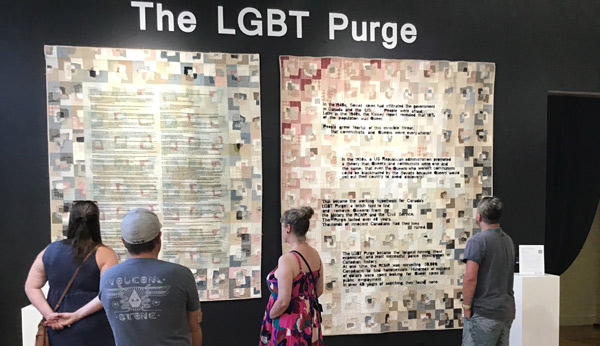
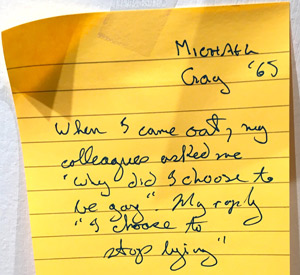
One comment read aloud said:
“I think young people today have no idea what it’s like to grow up knowing you’re different, but not knowing that anybody else is like you. When I was a kid, I knew I was different and I knew nobody felt the way I did, but I knew also that I didn’t know there was anybody else that felt like me.”
Along with the shared words from the almost 70 people he interviewed, those visiting the exhibition were encouraged to add their own words in thoughts and comments on colourful sticky notes, pinning them to a dedicated space for other to peruse.
“This is not my story, it’s everybody’s story,” added Stearman, “I just think it’s important.”

With these stories preserved within the fabric of the canvas, it is the hope that it isn’t intended as a one-off exhibition, displayed one week, and put away the next, as Stearman hopes museums, galleries and the like all across the country may be interested in hosting the exhibition in small towns, big cities, far and wide.
For anyone who may have ideas or suggestions for the exhibit to be able to continue delivering its message, Stearman would be pleased to hear from you at email: b.stearman@hotmail.com
In the meantime, for those that may have missed it, the exhibit’s next stop is at the Mississippi Valley Textile Museum in Almonte (just outside Ottawa).
Filed Under: Arts & Culture • Featured Articles • Local News