


Second failed vote on exploring to plan County waterworks future
Administrator | Sep 09, 2026 | Comments 3
By Sharon Harrison
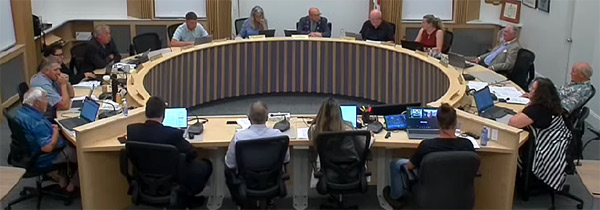
Brought back for re-consideration, a vote to accept a water/wastewater financial strategy report and approve exploration of options for planning for the next 10 years failed in 8-6 vote at Tuesday’s council meeting.
Following further lengthy discussion and mixed views, council opted not to accept the water/wastewater financial strategy report from Watson and Associates in any way, nor the recommendations of staff and the external consultant, that would have established a path forward, and refused to even look at possible solutions again. All seven recommendations were lost in the vote.
Opposed were councillors Roy Pennell, Brad Nieman, Phil Prinzen, David Harrison, Sam Branderhorst, Corey Engelsdorfer, Chris Braney and Janice Maynard. In favour were mayor Steve Ferguson and councillors Bill Roberts, Phil St-Jean, Sam Grosso, John Hirsch and Kate MacNaughton.
The decision would have cost nothing to implement at this stage it was noted, nor committed the County to anything, financial or otherwise. And while it was not the news some for hoping for, it is possible for the decision to come back again to the new council for consideration should they decide to take that route.
“The staff report, supported by the analysis from Watsons, shows we can afford to do this. It is more financially comfortable if we get front-end contributions from developers, and more provincial and federal grants, but even in the extremely unlikely event that those contributions don’t happen, the strategy is still doable,” explained councillor John Hirsch. “Following this strategy allows us to protect $39 million in grants already committed, which would otherwise have to be foregone.”
“With respect to scenario 2B, the phased development approach to renewal of our water and wastewater systems, the report makes it incontrovertibly clear that any other option is more expensive and has a worse impact on the rates for our existing ratepayers,” added Hirsch.
Tuesday evening’s vote was an almost repeat of the initial Aug. 27 committee of the whole decision which lost in a 6-6 tie vote, with councillors Brad Nieman, Corey Engelsdorfer, Chris Braney, Phil Prinzen, Roy Pennell and Janice Maynard opposed.
It was stated council’s decision could stall development and growth; leave risk and uncertainty of water and wastewater infrastructure upgrades and replacement (with associated potential safety concerns), as well as even higher water rates increases for residents on the municipal water system.
Significantly, it puts in jeopardy existing and potential government funding and grant opportunities, as well as the potential for securing development charges, front-end financing agreements and the like, from developers.
Several developers spoke at the meeting, including representation from Base31, along with the Quinte Homebuilders Association (QHA) who spoke to “the cost of doing nothing” .
QHA CEO Ruth Estwick reminded that approving the decision tonight costs zero dollars, and approving the strategy does not approve construction and is not a commitment to council to spend significant dollars.
“It approves the framework that allows the work to continue more understanding the cost, determining who should pay what, updating the development charges background study, pursuing available funding, and determining how infrastructure can be phased.”
She said it is impossible to build homes without a plan or a framework, reminding that costs remain with or without growth. Their message was simple, she said: “doing nothing does not make the infrastructure challenges or its costs disappear; it changes how those costs are managed, who ultimately pays them, and potentially how much more they cost”.
Councillor Janice Maynard said, as written, she can’t support the motion.
“We have been informed that some of the outcomes that were recommended were based on flawed data,” said Maynard. “We also know now since this report was authored that there has been pretty significant economic climate changes. We do not know when that will change, whether it will get worse, whether it will get better, and a lot of it is premised to that economic climate, a lot of this is precedented on having some up-front or grants available.”
Maynard said the report needs another look.
“And the fact that we heard that it was based on flawed data is for me a game stopper. This whole study needs to have a good re-look and come back to next council.”
COA Adam Goheen said the body of work staff has put forward in the last year is based on new, updated information and “is not based on flawed information. It’s unfair to characterize the work that’s been done in the last year as flawed”.
Councillor Phil St-Jean outlined the reasons why the motion should go forward, along with his concerns for the safety of Picton’s drinking water.
“We keep hearing statements from members of council that the developers should be telling us how much money they are going to give us. They can’t tell us how much they are going to give us unless we have a plan and show them how much it’s going to cost. Without a plan you have no idea what it’s really going to cost,” said St-Jean.
“Threats to Picton water supply is something that has gone undiscussed because the threats are real. I am very much concerned about the future of the drinking water supply for all of Picton, the entire area that is served by the current Picton water treatment plant.”
He referenced an earlier report by Quinte Conservation stating the identified 300 serious threats to the clean drinking water supply in Picton Bay.
“Our residents deserve to have clean, safe, reliable sources of drinking water, and currently they don’t, and everybody knows this.”
“We need to have a plan so we can talk to the developers, to be able to develop the other plans we have on the go. I’m really getting very frustrated with arguments that don’t hold water,” he continued. “Our job is to plan for the future. If we don’t plan for the future, then you are planning to fail. We need to do our damn jobs, and we need to plan for our community and by not moving this forward, we are walking away from our responsibilities.”
While the proposed strategy showed the municipality having to borrow $255.5 million over the next 10 years to build new water treatment facilities, along with annual increases in water/wastewater rates, the main point was to explore how the infrastructure program could be funded, and what options were available.
The lost vote sought council’s approval to explore all potential options more fully (at no cost other than staff time) – nothing more. Council’s decision shut down staff’s ability to even talk with developers and lenders, or explore funding opportunities.
Watsons strategy forecast focused on one-per cent annual growth for the County when it comes to infrastructure planning equals roughly a projected 150 new residential units annually.
“A framework and a plan is really just about allowing us to make better decisions about setting a direction which we all know we have to do… and is the thing that helps us manage risk. It just makes sense,” said councillor Bill Roberts. “Just imagine in your worst-case scenario, a Walkerton happening to Prince Edward County. Do we really want to take that chance?”
Mayor Steve Ferguson spoke to the tens of millions of dollars of funding and support received from the provincial (and federal) governments in the last several years to this small single-tier municipality, including the new hospital, the new long-term care home, the complete rehabilitation of County Road 49, water infrastructure funding, and a new roundabout, to name a few.
“Infrastructure and investment in infrastructure housing development is the number one priority of the provincial government. If we do not move forward we are at tremendous risk of losing future funding, provincial or federal, for water and wastewater facilities, the net effect of which will be higher costs for ratepayers, and sending a clear message to upper levels of government that may affect our ability to receive other funding in the future,” said Ferguson. “That is a very real concern.”
Ferguson also spoke to the risk of not approving the motion.
“Lack of support for developers, not approving sends the message that we are not open for business, and it also means the ratepayers will carry more financial burden and more people will be priced out of the market, and that will make Prince Edward County a much more exclusive community as urban money continues to move in,” he reminded. “And we will certainly lose provincial funding that was extremely hard fought for, and that’s a lot of money to lose because it’s got to be made up somewhere, and that would be the ratepayers. This is really important.”
The $255.5 million price tag suggests it would include a new regional water treatment plant in Wellington that would be intended to supply both Wellington and Picton and Bloomfield, to be constructed in phases as growth allows. Wastewater treatment plants would remain separate in Picton and Wellington (to include phased expansions and improvement as growth allows), with the Picton water treatment plant to be decommissioned once the regional plant in Wellington is up and running.
The staff report, Watson’s financing strategy report and the two presentations as discussed at the Aug. 27 committee of the whole meeting, can be found on the corresponding agenda item on the County’s website, along with the meeting recording for the Sep. 8 council meeting.
Filed Under: Featured Articles • Local News



































It will be interesting to see who comes to the rescue and who will ultimately flip the bill.
Council was wise to step back and resist the temptation to trust numbers that are questionable. Water ratepayers cannot be placed in such a vulnerable position. Ameliasburgh Councilors get the seriousness why can’t Picton’s?
This vote means that people who live in Picton and Bloomfield are in danger of ending up with a boil water advisory when our 100 year old water treatment plant breaks down. As Councillor St. Jean said. If you fail to plan you plan to fail!