


The meaning of the mulberry tree, and other fruitful sharings
Administrator | Aug 05, 2025 | Comments 0
 Venturing through the hip-high grasses of the meadow, a old piece of found wood acting as a stick to help guide and steady through the tall, scratchy vegetation, I was armed with a basket, camera (of course), a few lidded containers, a water bottle and snacks (since I thought I might be here a while). I felt like little red-riding hood (minus the hooded cape) with my basket looped over my arm, but there were no wolves around, I don’t believe. Mosquitoes, yes, ticks, yes, deer fly, of course, also giant biting red ants, but no wolves.
Having filled one container, then another in quick succession, I soon realized I had harvested more mulberries in one visit to one tree than I’d collected in all of last year’s harvest, and I knew this year’s pickings was going to be something to write home about, marvelling at the berry stash that was about to unfold.
The orchard of mulberry trees I was fortunate to inherit at this property kept me busy every day for nigh on three weeks, and as production decreases, I realize the harvest of delicious fruit is almost over for another year. I’m happy in one sense that the chore that filled my days for weeks on end is no more, yet sad in another because it had become a rather fun routine, and I almost rather it didn’t end quite just yet.
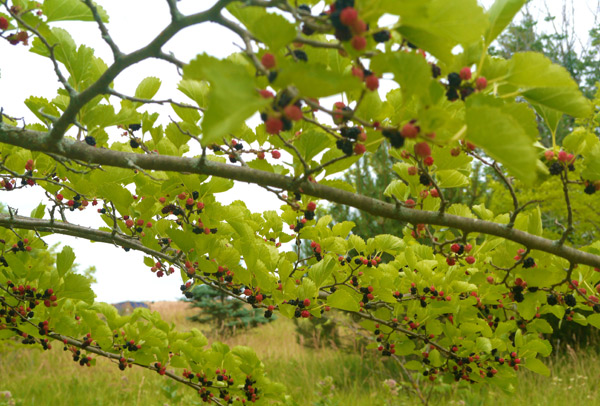 And it is at this point, harvest done, that I marvel at the mulberry trees, the prolific fruiting, amazed at how a tree can produce so many little berries, and keep producing them for weeks on end, especially in scorching heat and no rain. And I marvel at having become acquainted with the mulberry tree and its fruiting prowess, and wonder how I made it this far in life having never seen nor tasted a mulberry before, or learning of its super nutrient-rich qualities.
I have a distant memory of a mulberry tree existing near my English home town. A big and very old mulberry tree, where on May Day, the tradition was to dance around the mulberry tree where ribbons were attached. It wasn’t anything I participated in, and I can’t recall if it went on when I was young, or if I am just remembering reading about it happening generations earlier, and yet the memory is one of its existing in my time, but I can’t be sure.
The place is ancient and historic, many hundreds of years so, and one can only imagine the dancing around the mulberry tree was a thing back in the day, at least that’s what my memory attempts to suggest. The mulberry tree in questions is in a very historic little place aptly called Mulberry Green, and I visited some years back, and reports from family (who live nearby) are that the tree still stands today. But alas, the May Day dance tradition does not.
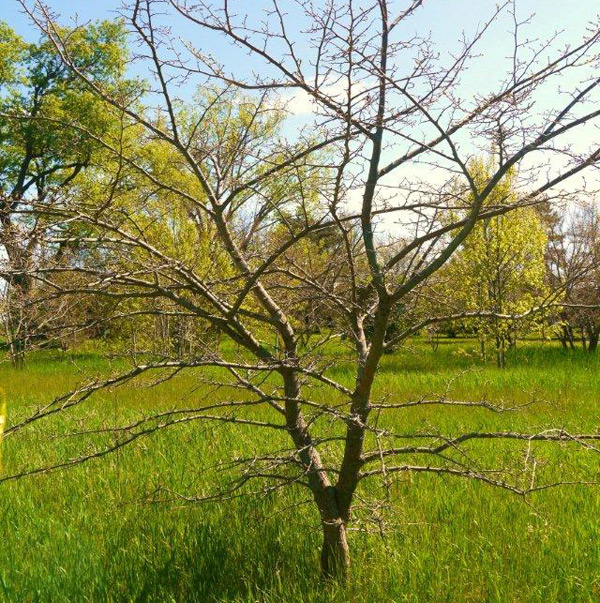
Foliage only just emerging in late May compared to other trees
At first, I was completely unaware I had mulberry trees, let alone a gathering of them, although I knew I had a whole bunch of unidentified trees. Trees without foliage at the time looked dead, a bit scrawny and even sort of petrified looking. They didn’t appear remotely attractive as a tree in this state, I didn’t recognize them, and I wondered if I even wanted them. The mysterious trees didn’t look like most other trees, the branches were scraggly, oddly shaped, growing in different directions, almost unfriendly and sort of prickly looking, and whatever they were, I realized there were lots here and so I was curious what they might be.
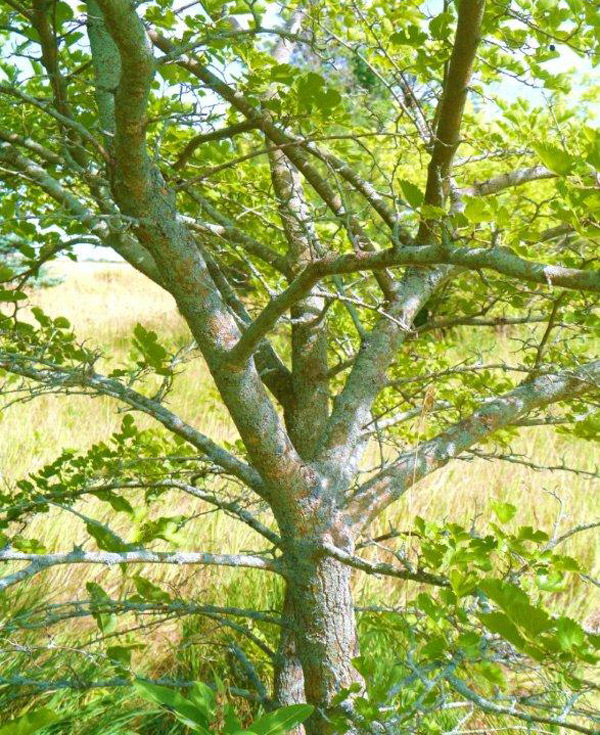 It proved a great surprise to learn I have mulberry trees in my new garden of new things, and not only do I have mulberry trees and an entire orchard’s worth, but I have mulberries. Unfamiliar with what the mulberry fruit looked like, I suddenly found myself with trees laden with them as they ripen daily over a period of many weeks through July. Mostly, they are far too high to reach and so they are my contribution to the birds, squirrels and insects, and whoever else gets to lunch on them, which they do in ways ferocious, determined and greedy judging by the elevated noise and activity. But who can blame them. The remaining haul, certainly a much lesser quantity, but still more than plenty, was my reward for the hard work endured (and the many insect bites, and countless scrapes and grazes incurred).
 While I only have last year’s berry haul to compare, and it was reasonably good show, this year was a big, massive, huge, bumper crop where I have never seen so many berries on a single tree that just keep coming and coming and coming, the lush trees dripping with fruit for weeks on end. Was it the extreme heat day-after-day, was it the lack of any moisture, or was it just the right conditions earlier in the spring, cool and wet enough to give the trees an ideal start, I’m not sure.
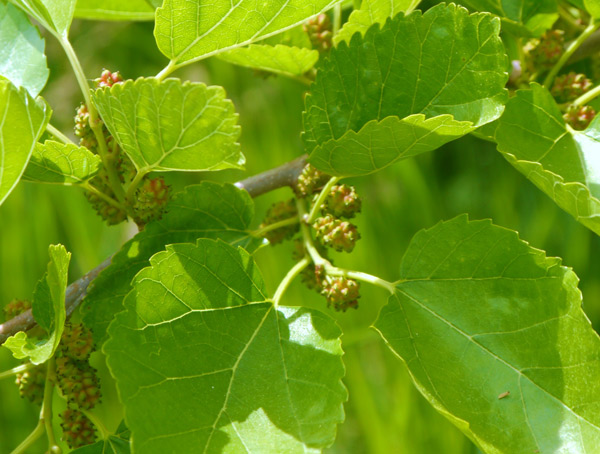 What I also found quite remarkable on this mulberry discovery is how quickly the mulberry trees transform from dormant winter state, where the process seems to happen in the blink of an eye. They are probably the first trees to lose foliage in the fall, and the last trees to come into leaf in the spring. There was no sign of foliage mid-May, yet by mid-June there was fruit developing, and when Canada Day hit, the berries were ripe for picking. The turnaround simply astounds.
Taking just mere weeks after the foliage appears, they have produced ripening fruit by the bucket load in no time at all. The flowers part puzzles me though. Even when I was paying close attention this spring, because I was curious what the flowers looked like, I didn’t see any. Whatever the mulberry tree is, I find it quite a remarkable species to be able to produce a harvestable crop so quickly, and to do it with such splendiferous results.
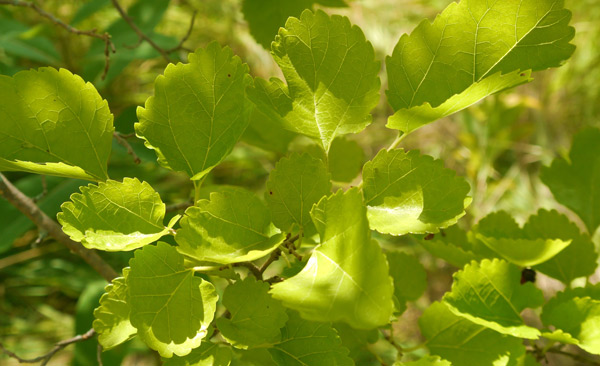
Note the very light green leaves even in mid summer
This curious and prolific fruitful tree also comes with different foliage where the leaves vary in size and shape depending on the tree it seems. I wondered if some were male and female, which is common in fruit trees especially that both are needed to pollinate, but no, the mulberry is apparently self-fertile and doesn’t need a mate in order to produce fruit. And another observation is that the foliage remains the lightest, freshest, spring-like green all season long, as if it had just emerged.
With July now officially declared mulberry picking season, I must confess the picking part was a task, the soft fruit so tiny, it was hard to grasp the things without squishing, and yet encountering my very first orchard of mulberry trees, and indeed my first up-close acquaintance with the tree and its fruit, I felt they must be picked and used (frozen for later use, and they freeze really well).
The mulberry fruit resembles a blackberry, only smaller and slightly thinner and more elongated, and while the size varies, they are not much bigger than pea-sized. First appearing red (like a raspberry), turning the deepest purple (almost black like a blackberry) as they ripen. And they are quite tart so consuming them during picking wasn’t an option. And yet no sooner did I observe that, everything changed. The thing about them being pea-sized isn’t always so, and the thing about them being tart, not necessarily.
During my several weeks of picking, the berries got larger, more like an elongated blackberry you read about, only until now, mine weren’t elongated or long, just tiny and round. As the days got hotter, the berries grew larger. And as the berries got bigger and plumper, the taste got better (less tart), and while not overly sweet, they were deliciously just right. So while I wasn’t initially consuming them as I was picking, I started eating while picking where the big, very ripe berries glistened black in the blisteringly hot sunshine, so juicy, they instantly burst in my mouth, oddly warmed as they baked on the trees in the hot July sun.
The fruit of this very strange but wondrous tree doesn’t really need to be picked in the traditional sense of the word, because just touching the ripe fruit (or the branch), or nudging it, immediately releases the ripe fruit so they fall to the ground. And so, after so many weeks of picking, I eventually figured out the more efficient way to extract the mulberry fruit where my technique steadily improved and I soon had the task down to a fine art.
The fruit is odd in that it grows very close to the branch as if directly attached or hugging it (the fruit having almost no stem), and while there is so much fruit you don’t exactly have to hunt for it, the foliage (more dense on some trees, sparse on others) made a good hiding place for the ripening fruit. And just when I was sure I had finished one tree, and was ready to move onto another, I soon learned that by standing right under the canopy, much more ripened fruit is revealed, and so the task of picking resumed where most days it seemed like it was never ending.
I soon realized the picking would be a messy endeavour, where everything turned purple: my clothes, my sandaled feet, and especially my hands and fingers that remained somewhat permanently purple-stained for those weeks. As the birds squawked and dived around and above my head sharing the generous bounty (somewhat reluctantly on their part), they attacking the upper-most parts of the trees, I picked the lower branches, I thought if this was bear country, I’d have more than angry birds to worry about. It would be nice if it was bear country, but I am glad it is not, and there were no wolves either, just many, many berries…so many berries.
Click here for more gardening columns by Sharon Harrison
-A gardener all her adult life, and much of her childhood, Sharon Harrison blames her parents for this predicament, both of whom are life-long gardeners and growers of good things, nonetheless grateful for the gardening genes, and the growing passion.
While she has written on countless topics over many years for numerous publications and media, her heart remains rooted in her Prince Edward County garden as a grower of beautiful, strange and sometimes ordinary things, inspired and influenced by nature, wildlife and the fragility of environment.
Filed Under: News from Everywhere Else • Sharon Harrison