


Two proposed solar farms receive support resolutions to move to IESO
Administrator | Sep 10, 2025 | Comments 0
By Sharon Harrison
Two separate solar farm projects proposed for Prince Edward County, up for consideration at Tuesday evening’s council meeting, have received council support.
In each case, the proponents were seeking a municipal support resolution from council to meet a provincial government deadline of Oct. 16 in which to submit an application to the IESO (independent electricity system operator).
Without municipal approval, the proponents would not be able to move forward with their projects as such government contracts are only considered with local municipality support – a requirement under the Long-Term 2 Energy Supply request for proposals procurement process.
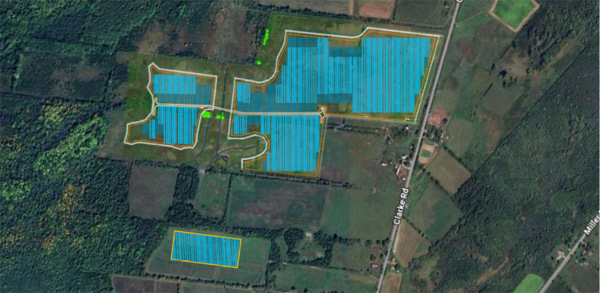
The first proposed solar project is by Prince Edward Solar 1 LP, for a 180-acre piece of land at 772 Clarke Road, known as the Prince Edward solar 1 solar generation project. It is to be a partnership between Alectra Energy Solutions and Montreal-based Kruger Energy (50 per cent stake), and the Mohawks of the Bay of Quinte who will also be a 50 per cent owner in the project.
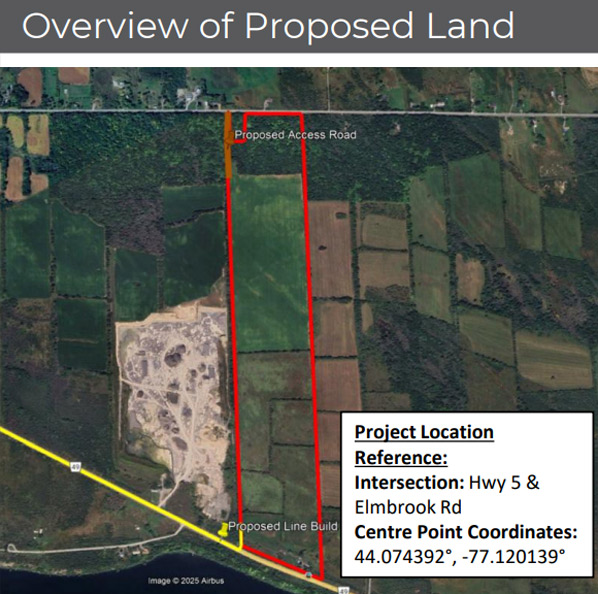
The second proposal is for Toronto-based Elmbrook Agrivoltaics Inc. (a subsidiary of Compass Greenfield Development) for the proposed Elmbrook agrivoltaics solar project has its stated location on a 148-acre parcel of land at Elmbrook Road and County Road 5. The official address: 1867 County Road 49. This proposal originally came before committee of the whole on June 26.
While staff provided a report for each of the proposals, they did not provide any recommendations for approval or denial for council’s consideration in these cases.
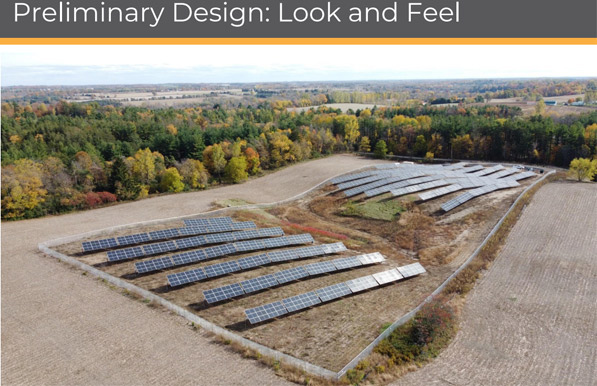
Each proponent provided a deputation to council outlining the details of the proposed projects, what they will consist of and how they will look, what the timelines will be, and the merits of proceeding with the projects, such as the benefits (including financial) to the municipality and the community.
Along with solar panels, the Elmbrook Road project will bring around 200 sheep to the site to graze the land of the project site as solar energy is being generated. It is intended that the sheep will maintain the vegetation within a fenced area, where the animals can find shade from the solar panels.
Furthermore, it is anticipated that a second phase of crop growing is expected to be established over the life of the project as potential crop production is explored for the site.
Noting that the Alectra project (Clarke Road) came up with $2,000 per megawatt acre as a municipal incentive, councillor Bill Roberts suggested Elmbrook Agrivoltaics came up a little short at offering the municipality $1,000 per megawatt acre. While James Marzotto with Compass Greenfield Development said it was an “opening offer”, Roberts said he would like to see Elmbrook come back at $2,000.
Roberts however praised the Alectra (Clarke Road) project for including the Mohawks of the Bay of Quinte in a 50 per cent partnership and said he is looking for a similar equity position for the Elmbrook Road project. Marzotto confirmed they are seeking an indigenous contribution, and are still in negotiations.
Speaking to the Elmbrook project, councillor Sam Grosso said, “I am all for solar energy, I think it is a amazing thing here in Prince Edward County”, but his main question asked how much soil there was (and was there shale or bedrock) and how the steel piles would be screwed into the ground.
While Marzotto said they don’t yet know how much soil there is, testing was being done, where he indicated the landowner believed it to be less than two feet of soil.
When it came time to vote on the Elmbrook project, councillor John Hirsch said he cannot support any of the solar projects.
“It still doesn’t fit into the way the energy grid works in Ontario, there is no battery storage in this area, so on days when solar panels are producing electricity that’s not needed, are you going to be paid to generate that electricity that won’t be used,” expressed Hirsch.
Councillor Sam Branderhorst asked about the mowing at the Clarke Road location, given that sheep would take on the role of mowing at the Elmbrook Road site.
“Would they leave it predominantly unmowed? Does it have to be completely mowed?” she asked, adding that she was looking at the benefit for natural pollinators.
Kevin Whyte with Alectra Solutions confirmed it would be mowed and properly maintained and a local company would be hired to do so.
“Does it have to be every inch of it completely mowed?” Branderhorst added, “Is there an encroachment area that could be left as field grass?”
In his report to council, Scott Pordham, County policy co-ordinator, said it is important to note that providing a municipal support resolution does not constitute approval of the development. The final design for the project would be considered during those planning processes
“Should the proponent be successful, then project approvals would be required at all levels of government. From the municipality, applications for a zoning bylaw amendment and a site plan control application would be required should the proponent be successful with the IESOs request for proposal.”
Pordham noted that both infrastructure projects “will bring significant investment and local benefits, including employment, lease payments and capital spending in the local economy”.
The main reason behind the desire and interest for companies to build more solar farms in the County originates from the Ontario government’s call for an urgent need for more power to be generated in order to meet both current and future demand.
“In October 2024, Ontario’s IESO updated its demand forecast for Ontario and indicated that it is anticipating a 75 per cent increase in energy demand between 2025 and 2050.”
The primary drivers for the growth and the large increased demand in the near and medium-term come from the industrial sector and data centres. Other drivers include industrial electric vehicle production and supply chain sub-sector, commercial sector growth, increasing population, and electrification are also continuing to escalate electricity demand across the province.
Only one member of the public spoke at the meeting with County resident and farmer John Thompson indicating his support for the Elmbrook Agrivoltaics project, especially noting how the project will generate electricity without creating any CO2 emissions.
“No valuable farmland will be lost, but the value to society of this larger land’s contribution will be increased,” said Thompson, who also spoke to other’s opposition of the project.
“I do not accept the opposition criticism that the energy will not be used locally, but shipped into the grid,” he said. “We survive by being part of the grid, and we should be contributing power whenever we reasonably can. The electrons will flow to the nearest source where demand is found, so that could be us. However, and very fortunately, the grid system means that we are all in this together, so let’s do our part.”
Mayor Steve Ferguson acknowledged that letters had been received from the chair of APPEC (Alliance to Protect Prince Edward County), Gord Gibbins, opposing both projects.
More information on the two solar projects can be found as part of the agenda on the County’s website.
~ ~ ~ ~ ~ ~ ~
A brief outline of both projects is provided below:
 PRINCE EDWARD SOLAR 1 SOLAR GENERATION PROJECT (CLARKE ROAD)
Proponent: Prince Edward Solar 1 LP. A partnership between Alectra Energy Solutions and Montreal-based Kruger Energy (combined 50 percent stake), and the Mohawks of the Bay of Quinte (50 percent owner in the project). (Note: Convergent Energy and Power is no longer a partner in this project).
Location: 772 Clarke Road, Picton, north of Miller Road, with 780 metres of frontage on Clarke Road.
Land size (approx.): 180 acres with project to occupy 80 acres (land leased from private landowner).
Land designation: Rural (per official plan); Rural 3 (RU3) per zoning bylaw
Generation: 15 megawatts
Benefits to the municipality: $2,000 per megawatt acre paid annually to municipality (20-year contract). Gross property taxes will be approximately $30,000 in first year.
The lands are occupied by a farm including a dwelling and barn and most of the lands appear to be farm fields, noted Pordham’s report. A watercourse is identified that runs north to south through the middle of the property, and the most westerly portion of the property is part of a natural core area (NCA) associated with significant woodlands.
“The zone does not permit a solar farm. Furthermore, private power generation facilities are not permitted as of right under the public use and utility provision as defined the zoning bylaw,” stated Pordham. “The proposal will require the approval of a zoning bylaw amendment application should the proponent successfully obtain a contract from the IESO.”
He also notes that an environmental impact study and a hydrogeological study can be required.
“As the property includes a watercourse and the project is in close proximity to a NCA, an environmental impact study will be required to confirm that there will be no negative impacts and identify any mitigation measures that need to be taken.”
ELMBROOK AGRIVOLTAICS SOLAR PROJECT (ELMBROOK ROAD)
Proponent: Elmbrook Agrivoltaics Inc. (a subsidiary of Compass Greenfield Development)
Location: Elmbrook Road and County Road 5 (officially known as 1867 County Road 49), Picton, with 325 metres of frontage on County Road 49, and 200 metres of frontage on Elmbrook Road.
Land size: 148 acres (land leased from private landowner).
Land designation: Rural per the official plan, and Rural 3 (RU3) in the zoning bylaw. The lands are mostly farmed, but it is not prime agricultural land.
Generation: 22 megawatts (revised from 15.5 megawatts), with 20,000 panels
Benefits to the municipality: $1,000 per megawatt acre paid annually to municipality (once commercial operation begins) amounting to approx. $22,000 per year; plus increased tax base to the municipality (gross property taxes will be approximately $21,000 in first year), for a total of $43,000 per year for the municipality.
Benefits to the community generally include a stronger local energy grid providing power to meet growing demands in Ontario, a diversified income stream for landowners in terms of lease payments paid to the landowners by the proponents, optimized land use, and short-term job creation (from construction) and therefore economic stimulus. Local economic benefits will exist during the design, construction, and over 20 years of operation.
Filed Under: Featured Articles • Local News