

County still financing housing corp. as debt builds with nothing built
Administrator | Nov 22, 2026 | Comments 0
By Sharon Harrison
“The housing corporation is in a net debt position, meaning that there are more financial labilities than there are financial assets, and that does continue to grow,” stated Katie Mahon, partner with KPMG.
A special shareholder meeting of the Prince Edward County Affordable Housing Corporation took place on Nov. 9, with its audited financial statements (to year-end Dec. 31, 2025) being presented by Mahon, along with a report.
 STATEMENT OF CHANGES IN NET DEBT
It shows the housing corporation with $739,917 in liabilities, and debt of $125,006. Assets amount to $614,911 (cash), with non-financial assets totalling $859,468 (Niles and Disraeli Street properties).
Presented along with the statement of financial position was the statement of operations and accumulated surplus, the statement of changes in net debt, and statement of cash flows.
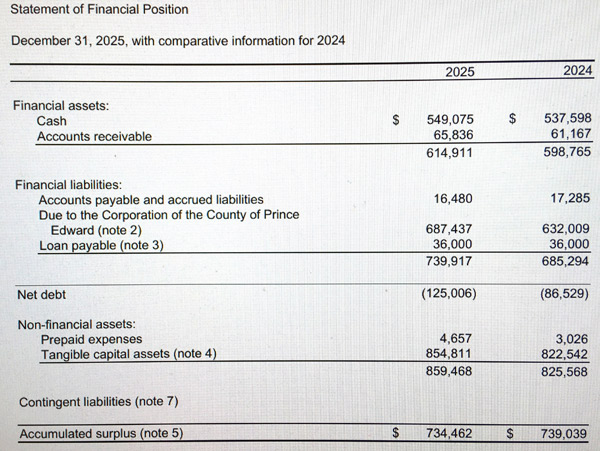 STATEMENT OF FINANCIAL POSITION
The balance sheet for the financial year shows the corporation’s assets are $549,075 (cash held in the bank) plus $65,836 (HST receivables) for total assets of $614,911 – around $16,000 more than in the year prior.
Its financial liabilities amount to $739,917 (up by more than $54,500 from prior year), of which $687,437 is monies owed to the County. It also includes a $36,000 loan fee for the KPMG audit, plus accrued interest.
“The County is paying most of the bills, acting as a banker for the housing corporation and that changes year-over-year with the County balance,” said Mahon.
“The KPMG audit fee as well as the accrued interest on this $36,000 loan payable, so that loan payable was triggered to be re-paid at the end of 2023, so we have two years of accrued interest on that as the loan balance has not yet been called.“
This leaves the housing corporation $125,006 in debt ($38,500 more than in prior year).
However, non-financial assets do total $859,468 ($34,000 higher than prior year) made up primarily of the Niles Street property (former old Wellington arena site), valued at $784,093; and Disraeli Street site valued at $70,718.
Note: In the audited financial statements, KPMG repeatedly refer to “Wellington Street” – it is thought that this is referring to the Niles Street property, although it is unclear why the reference to Wellington Street. This was not brought up or clarified at the meeting by either KPMG or the board.
Mahon said there is no amortization on the sites as they are not currently in use.
“They are classified as either land which never gets appreciated, or work-in-progress assets for the development costs, which will stay unamortized until they move forward with a decision on how they will be put into use.”
“We saw the first year of that net debt position a few years ago, once the structure of the housing organization changed a bit where the grant funding or the levy funding wasn’t coming through as a revenue source,” explained Mahon. “As a result, we continue to see that net debt balance increase.”
Speaking to the accumulated surplus of $734,462 (non-financial assets less net debt), Mahon said the reason why this is an important note to look at is it does show where those funds are.
“It does actually show that even though there is $734,000 on an accumulated surplus position, most of it is tied up in those capital assets and having an operating deficit in the corporation of just over $84,000,” she explained. “That is a little bit of a unique presentation of non-profit organization public sector and is not as straight forward.”
 STATEMENT OF OPERATIONS AND ACCUMULATED SURPLUS
With revenue of $11,478 (bank interest), and expenses (professional fees, bank charges/interest, insurance, office expenses) of $16,055, that leaves an annual deficit of $4,577.
Mahon noted nothing significant or unusual, no corrected or uncorrected items were found during the audit and no disagreements with management, no perceived or actual conflicts of interest were identified. “It was a very clean and smooth audit process.”
It was indicated that the financial statements present fairly in all material respects, where she noted that materiality is an important audit concept. “We don’t audit down to the penny, down to the dollar, we do audit to that level of materiality.”
She said it has been determined that materiality for the year is to be $7,000.
“It is a relatively small dollar value, but it is relative to the size of the operation,” she said. “So, how we came up with that $7,000 is a percentage of your total assets, and total assets would be the expected or customary benchmark for a non-for-profit public sector entity that is in the development stage where the custody of assets is the main trigger point for users of the financial statements.“
While completed over the summer and finalized in August, two prior attempts to present the financial statements failed, the first time in September when the County’s finance staff didn’t show up to speak on the item, and KPMG was not scheduled to present at that time. The second attempt, in October, also unsuccessful due to an internet outage.
Speaking to the timing, board member Hilary Spriggs asked Mahon what the biggest impact on the timing of receiving these audit documents was when they did, and whether there was anything that could have been done to get them earlier in the year.
“I ask because we did have some challenges this year dealing with some of our financiers who were asking for audited statements and we didn’t have anything in advance of 2024,” revealed Spriggs.
The timing of the audit has always historically been combined with the timing of the County audit, and then typically the County being such a large audit would be done first, confirmed Mahon. She said from the time they received the information to turnaround, the audit was quite quick.
“From a process perspective, if there is a requirement to move it up in future years, we could separate it so it’s not tied to the County’s, and that could be a discussion, but it is a fairly simple and straightforward audit that if we were able to get the information, we could certainly get the audit completed earlier.“
There was also discussion around whether the audit fee could be re-negotiated, but also whether an audit is needed at all due to the revenue expenses being very small. However, Mahon confirmed that because the corporation is affiliated with the municipality as a municipal corporation, the audit is required. She also confirmed that should the housing corporation grow and have more transactions, the audit fee would increase accordingly.
It was mayor Steve Ferguson’s last meeting as shareholder with the housing corporation (since he didn’t stand for re-election) and he thanked everybody for their contributions.
“The recognition of the needs of the municipality are not lost on anybody, and I am so thankful to the public members who have come forward, and I think the group of public members we have as part of the organization now are really spectacular with the expertise you bring forward and your passion to help the municipality out,” shared Ferguson.
“Also, thankful for the council members who have put so much time and effort into this work, and, of course, to the staff that make the whole thing run incredibly smoothly, so thanks very much everybody. “
The full audited financial statements can be found on the corresponding agenda item for the special shareholder meeting of the Prince Edward County Affordable Housing Corporation of Nov. 9 (found on the County’s website), along with the meeting recording.
Filed Under: Local News